Why Tom Wolfe Matters

What more can I add to the multitude of tributes to literary legend Tom Wolfe? Certainly nothing unique, but given the inspiration he has provided me, it would seem irresponsible not to add a few personal notes.

Wolfe is one of my favorite authors of all time. He was a writer who changed my life. I never met him, but I always felt like I knew him. Now I will miss him, but the library of his life’s work will forever be near me.

It was his invention of New Journalism that changed the way we heard and told stories. He crafted a new set of norms meant to break all the rules that desperately needed to be broken. The storyteller belonged in the story, fact or fiction, a hard break from the false mandates of objective absolutes. He proved by example that a writer and his story are inseparable, no matter the subject matter. His biting critiques of hypocrisy are funny, eye-opening, and actionable. His characters are equally outrageous and believable. The unique style and consistent unpredictability of his prose are seldom short of stunning.

When I first read his 1989 manifesto in Harper’s, “Stalking the Billion-Footed Beast,” I knew the coming shift in literature was more than cosmetic. Allow me to borrow a passage from that essay on how the call to relevant storytelling so lit up my life with hope and gravitas:

By the early 1960s, the notion of the death of the realistic novel had caught on among young American writers with the force of revelation. This was an extraordinary turnabout. It had been only yesterday, in the 1930s, that the big realistic novel, with its broad social sweep, had put American literature up on the world stage for the first time. In 1930 Sinclair Lewis, a realistic novelist who used reporting techniques as thorough as Zola’s, became the first American writer to win the Nobel Prize. In his acceptance speech, he called on his fellow writers to give America “a literature worthy of her vastness,” and, indeed, four of the next five Americans to win the Nobel Prize in literature—Pearl Buck, William Faulkner, Ernest Hemingway, and John Steinbeck—were realistic novelists.

Wolfe reminded us of our American legacy and tradition in creating words that matter. To combine that public statement of reborn intent with a social novel as demonstrative as The Bonfire of the Vanities would have itself constituted a life achievement, but he was just getting started. Ironically, this was years after he wrote The Electric Kool-Aid Acid Test and The Right Stuff in his relative youth. Whether the narrative was reported, invented, or a combination of both, his voice exploded from every page he published and lifted us to reconsider the controlling norms crowding every corner of our lives.

He was already in the club when he dusted off the house rules. To be fair, it was less of an edit about purpose than it was a bold restatement of the rules of engagement. These were the kind of “new rules” that deeply appealed to young writers like me who weren’t sure if it was still okay to address the injustice of our surroundings with purely accessible plots and characters.

Could an author be both mainstream and thoughtful, both entertaining and aspirational? Wolfe told us yes, showed us how, and begged us to beat him at the game. Eleven years after Bonfire he proved he could tackle the social novel in different geography with A Man in Full, bringing realism and nuance to an equally vibrant cast of characters in the financial machinations of Atlanta. Again he beckoned all comers to rise to a more demanding creative standard. We couldn’t beat him, but we sure could take out pen and pad and play along as if the contest were open for anyone brave enough to enter.

What did I learn most from this erudite iconoclast?

Current events become history. Tell even the simplest stories with flair. What you chronicle for the present becomes a time capsule that can be unwrapped in ten years or a hundred. Reporting on contemporary events is a noble calling, but framing them within multiple prisms of context transforms ordinary happenings into perpetual discussions of culture and significance.

Story and storyteller are inseparable. Voice is alive whether you are writing fiction or non-fiction. To pretend otherwise, that there is somehow an ideal objectivist viewpoint, is to deny the reality of the music in your head and the muse speaking through you. Acknowledge it, confess it, embrace it.

Style is content. What you write and how you write it are also inseparable. So many of us studied his eclectic, eccentric style of phrasing to adopt his craftsmanship and tone. If you want to use nonsense syntax to land a point, to hell with copyeditors, be a writer, accentuate at will and rise to the iconic. Like this, from Bonfire: “On Wall Street he and a few others – how many? – three hundred, four hundred, five hundred? – had become precisely that … Masters of the Universe.”

How big a deal was Tom Wolfe? I can’t identify a single reductive adjective. Enormous is a good start. Unique is another. I’d toss in galvanizing as well. His writing changed the entire playing field for a churning generation. He showed us how words become possibility. Yes, he was that big a deal.

Important works of literary fiction that are fully absorbing may not be in the same demand today as they were a generation ago when readers of another time learned to love words as life inspirations. When we remember Tom Wolfe as author and provocateur, we remember what is possible when we demand as much of our artists as they demand of themselves.

Words matter. Stories matter. Storytellers matter.

Tom Wolfe matters.

_______________

Photo: TomWolfe.com

The Compartments We Devise


We never know the full story when we look into someone else’s eyes. It doesn’t matter who it is. Our spouses, our children, our friends, our business colleagues—we all have chapters in our stories that are as yet untold or never told. It will always be that way. The best we can do is get better at listening, remain open to compassion, and craft compartmentalization strategies to balance the myriad conflicts that attempt to overrun us even when we appear to be at our best.

Appearance is always deceptive. It’s why writers have something to write about. It’s why most of us like to read stories, see plays, and watch movies. We trust storytellers to reveal to us the points of backstory we need to piece together a coherent narrative. Sometimes we call that entertainment. Other times we call it the awakening inspired by a cautionary tale.

Life instruction is much harder. Think about the people you will encounter this week. Which of the following might they be experiencing and trying to integrate into the disjointed career demands of their workplace and the to-do lists filling their calendars:

  • Might they have a dear friend in the hospital with a terrible disease?
  • Might they have just learned one friend is getting divorced and another divorced a year ago in silence?
  • Might they be looking for ways to support people living far away whose lives are being devastated by a natural disaster?
  • Might they have bet heavily on a seemingly safe investment and lost enormously in its bankruptcy?
  • Might they have heard from the IRS that no matter how careful they were on their tax filings they are being audited?
  • Might they have recently discovered their retirement savings will not sustain them as they had planned for decades?
  • Might they have signed up for a critical deadline at work that is no longer achievable?

Don’t fret; odds are not all of this is likely to happen, at least not at the same time. Yet no matter how well things may be going or appear to be going for someone, you can be assured strife of some sort is lurking behind the curtain. None of us are invincible. None of us can entirely hide from adversity.

You never know any of this is happening to someone until it is revealed—and often it is never revealed, or revealed so long after it occurred you can be of no help. Other times it is you who are overwhelmed by the conflicts hidden from others. Life’s twists and turns find us all. We all have stories no different from tales we read, built on conflict, secrets, revelations, and resolutions.

Some people are better at maintaining the status quo no matter how hard they are being side-swiped in the dark. You know that person at work who seems superhuman, who just keeps delivering and never utters a peep about any kind of distraction or digression. You ask yourself how that person pulls it off. You wonder if such stoicism is sustainable.

Often these “superheroes” (or robots) are not as bulletproof as you think. They might just be very good at separating their life into components, ruling out clouding aspects of conflict to focus on the task at hand. That’s a skill, one that can be developed. Those who are particularly good at it know one thing for certain: it is not a magical power. It does not come with unlimited gas in the tank. It’s a bridge, and while it can be a long one, the beams supporting it are not infinite in strength.

Devising compartments is a coping strategy. Almost everyone figures out how to do this to survive, some better than others. When someone is too good at it, we might think them cold-hearted. That may seem an apt critique in the throes of emotional exhaustion, but it may not be a warranted conclusion.

When we segment our lives into compartments, we attempt to deal with difficult things separately, one at a time, one hour and one day at a time.

The problem with these compartments is that no matter how well we think we construct them, they all have not-so-secret wormholes connecting them. They send messages to each other through an impenetrable network. They shares walls of the same real estate. Those walls are thin by design.

Compartments are awkward. The storyteller knows this, which is why we listen to the storyteller. When the storyteller is ourself, there is all the more reason to listen.

Sometimes I think of song lyrics that have resonated with me and helped me develop perspectives on the compartments of my own life and those I observe in others. In his first solo album in 1984, Roger Waters of Pink Floyd wrote a very simple phrase that has stuck with me:

I recognize myself in every stranger’s eyes.

These simple words of reflection and contemplation put us all on the same playing field. When you take in the faces you pass along the street, each one constitutes a life that likely contains the same levels of success and failure, bonding and betrayal, health and illness, triumph and capitulation. The same holds true for school, for work, for community service, for the organizations you join for camaraderie and insight.

You don’t know the stories of the people around you any more than they know yours. Those stories are difficult and complex. The question is whether the obstacles in those stories will be overwhelming.

Sometimes you can help. More often you really can’t. When you integrate the compartments of your life with theirs, you can always move toward a path of shared understanding.

If you recognize the breakdown of artificial deconstruction in tales of fiction, you can recognize it in the real people around you. More important, you can trust yourself to see it in your own machinations. When you acknowledge the connections in your own compartments, they cease to be traps. That’s when compartments become shared spaces. That’s when real character building begins.

_______________

Photo: Pixabay

Movies That Most Influenced My Life (So Far)

Shortly before the 90th Annual Academy Awards aired this past weekend, I took an online quiz asking how many of the 89 previous Best Pictures I had seen. Somewhat to my shock, the answer was 70. While many of these were late-night film society screenings during college when I was a projectionist, that’s still a lot of wasted youth.

Or was it?

With this year’s Oscars behind us, I thought it an apt time to confess the 10 (actually 20) most significant commercial motion pictures that have impacted my thinking and creative process. You probably know I read a lot of books, but I wanted to share with you some of the filmed stories that have most shaped me as a writer.

Although a few of those 70 Best Pictures are noted below, many of my choices are further off the ranch. Should you agree or disagree, I hope you might share your own favorites with me privately or publicly, particularly as they have influenced your creative thinking.

These are not in specific order, although they are directionally stacked. They all matter to me, and while my reasons are kept deliberately brief, I hope some of the influences come through in my own writing as you may experience it. No apologies, this aesthetic is a bit of who I am!

1. Apocalypse Now (1979)

It’s based on Joseph Conrad’s forever-haunting Heart of Darkness. It was supposed to be Marlon Brando’s crown achievement, but that honor went to Martin Sheen. This Francis Ford Coppola masterpiece breathes the existential and freezes in time the horror of the Vietnam War with natural metaphor and nuance. “The End” by The Doors is the glue in its arc, and Robert Duvall demonstrates in a few brief lines that insanity is a product of subjectivity. The movie poster has been in my home office for over 30 years. It means that much to me.

2. All That Jazz (1979)

Bob Fosse’s unforgettably dark self-portrait took his kinetic style of dance and nonlinear storytelling from stage to screen. When I first saw Roy Scheider smoking in the shower it strangely gave me solace to know I wasn’t the only person who did that. I gave up smoking long ago, but not the image of this wildly imperfect creative force. Curious it was released the same year as Apocalypse Now. It is just as creepy, just as thought-provoking, and just as hard to imagine ever being replicated in rhythm or texture.

3. Amadeus (1984)

The stage version of Amadeus changed my life by forcing me to look into the eyes of gift and mediocrity, so the film version should have been doomed by physical separation of the ephemeral. Joyously it made it through the system unblemished and leapt off the screen with passion, suffering, orchestral grandeur, and tragic demise. Milos Forman’s adaptation to the screen has everything going for it except Tim Curry, and if you don’t know he’s supposed to be there, the rest is superb. As the Emperor Joseph II repeatedly concludes, “Well, there it is.”

4. Casablanca (1942)

If there were ever a need for proof that a movie could simultaneously be a romantic love triangle, a piercing polemic, an adventure story with life-and-death stakes, and a slice of life that looks at war caustically through the lives of individuals, this is the perfect brew. Toss in the eternal Humphrey Bogart and Ingrid Bergman and you barely notice the Nazis surrounding them. Well, you do notice them, you’re supposed to know they’re there. That’s what ups the stakes and allows the endless deflection of one-liners to be etched into memory.

5. The Wizard of Oz (1939)

It’s a perfect movie, from a perfect book, with perfect music and a perfect cast. It’s a living time capsule, and if anyone is delusional enough to think they’ll ever prove the American musical is not a serious form of art, make them watch this once a year for the rest of their lives. You’re probably starting to see from this list that I have a leaning toward musicals, but only when they have an edge, and only when they become a part of the soundtrack of our lives. That obsession begins with Dorothy and her rainbow.

6. The Right Stuff (1983)

Sam Shepard as Chuck Yeager in an adaptation of Tom Wolfe’s lyrical New Journalism account of America’s entry into the space race—if there is anything that can be put on-screen better, I’ll be first in line and watch a day’s worth of repeat showings. We can never forget this seminal chain of events in American history, because in so many ways the Mercury astronauts bridged the Second World War to the scientific present. Sam, Chuck, Tom, all heroes of mine, and director Philip Kaufman stitched together the launch plan and fired it into orbit.

7. Lenny (1974)

Before Dustin Hoffman gave into being the movie star version of himself, he played Lenny Bruce in a remarkable character study also brilliantly directed by Bob Fosse. I have been a student of Lenny Bruce all my life, and while there have been many renditions of who he was and why he mattered, Fosse pulled off the definitive portrait by pulling Hoffman’s strings and using editing as an interpreter to punctuate the sting of language in a world that needed to listen.

8. Stand by Me (1986)

I was never much of a Stephen King fan. His short story upon which this film is based, “The Body,” changed that forever. This grounded tale is presented as a simple coming-of-age story that is wildly not simple, but instead a real-life parable of the naive courage and joy of childhood that becomes the fear and challenges of our adult lives. Once in my life I hope to write a line of dialogue as solid and well placed as “Suck my fat, one you cheap dime-store hood.”

9. Patton (1970)

With Francis Ford Coppola behind the typewriter and George C. Scott owning the wide-screen, this “blood and guts” gem proved to me it was possible to make a highly political film that confirmed the biases of every side of the aisle. It’s pro-war if you want it to be, anti-war if you want it to be, and proof that a literary interpretation of history is a compelling way to get people talking with each other about decisions and consequences that matter.

10. Yellow Submarine (1969)

Please don’t laugh milk through your nose on this one, but if you know me, you know Pepperland is forever part of me. Okay, so I attempted to write a sequel when I was 17 because I loved The Beatles that much and knew I always would, but why is the toy sub on my desk, the iconic blanket on  my sofa, and the logo clock on the wall? I will never shake those Blue Meanies.

To be fully confessional, here are my 10 runners-up with even more restricted commentary, begging your imagination to extend my expository:

11. The Deer Hunter (1978)

Meryl Streep arrives in an epic yarn where the horror of Vietnam is actually fictionally manipulated to make the idea of war even more horrible than the reality. The creative license pushes credibility to the wall, but with reason and deliberate intention to make change happen.

12. Field of Dreams (1989)

Fathers, sons, loss, regret, unanswered voices, spiritual rebirth, Iowa cool, and baseball. If you never played the game it still makes you feel its gravitational essence.

13.  2001: A Space Odyssey (1968)

Kubrick and Clarke saw a future spectrum the rest of us wouldn’t inhabit for decades. Scoring it with Richard Strauss and Johann Strauss was even more mind-blowing.

14. Network (1976)

Paddy Chayevsky sculpted the words and Peter Finch enshrined them: “I’m mad as hell and I’m not gonna take it anymore.” Now we live this.

15. The Unbearable Lightness of Being (1988)

Love, sensuality, and fleeting artistry exploded by the Soviet invasion of Czechoslovakia in 1968. Author Milan Kundera distanced himself from the film, but director Philip Kaufman never lets your eyes leave the characters on-screen.

16. Hair (1979)

Another Milos Forman interpretation of culture and generations run amok, proving that stage-to-screen musicals can last forever when they hit every note. The Age of Aquarius lives embedded in Central Park.

17. Pink Floyd The Wall (1982)

Director Alan Parker puts his blustery visual stamp on one of the most enduring rock concept albums and alienation conceits of all time. Fascism is revealed for skeptics in connect-the-dots human unraveling.

18. Dead Poets Society (1989)

Behold the living argument against cynical compromise that makes poetry relevant and teachers the vital yet imperfect heroes to our younger selves.

19. Midnight Express (1978)

This nerve bender could be the case study for “Just Say No.” If this Alan Parker film written by Oliver Stone didn’t scare you off from crossing borders with the wrong stuff, your bravado was misplaced.

20. Young Frankenstein (1974)

It’s a slapstick comedy with literary roots that never stops being funny. Mel Brooks is a national treasure.

Well, that’s a wrap. I told you it was an eclectic and eccentric list, but some of each of these is in the stories I tell, the characters I share, and the images I try to illustrate. I hope this sheds some light on my world and opens a dialogue between us.

Dialogue, yeah. I do like dialogue!

_______________

Photo: Pexels

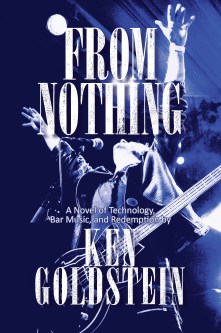
My Third Book: From Nothing

Writers by affliction are an idiosyncratic lot. Other than a willingness to spend an enormous amount of time alone and a preternatural love of language construction, we don’t have all that much in common. We write about different things, from the historic lives of dead people to the ponderous calculations of romance that could never live up to its description. Some of us have enviable discipline in reserving hours for our craft day in and day out. Others are beasts of procrastination who binge occasionally in overnight typing sessions while devoting daylight hours to cleaning out pencil-stuffed drawers and ceiling fan lint. An author on tour may enjoy speaking publicly, while another cowers at facing readership in the form of human flesh.

We may share a passion for literary achievement, but we are in few ways the same. One bit of sameness has occurred to me exactly three times, each when I’ve finished one of my novels. When the final copy-edit has put the book to bed and readied it for your consumption, I’ve invariably asked myself the same simple question:

“Why did I do that?”

The existential query is unavoidable. Why does a writer remain dedicated to the challenge of completing a book? I am guessing I am not alone in that meditation. It is impossible to think that most of my colleagues and the legions of our predecessors have not asked themselves the same thing. It’s a heck of an endeavor, for most not particularly lucrative. It disarms the writer to a battalion of transparent critics, and the incomplete satisfaction is resolved only in the reborn commitment to attempt it yet again.

So I ask you, as you are likely to ask me: Why bother?

To say that we are without choice in the matter may sound glib, but I am afraid that is the only reasonable answer I can muster. We do it because we can’t not do it. We do it because there is something inside of us that needs to ferment and emerge, to escape the confines of a sole mind and become part of a shared consciousness. If we could avoid or redirect this need many of us would, but we cannot, and so we sit, ruminate, draft, and revise. Somehow the new book becomes complete and we are ready to share it, with the best of intentions. For me, happily that time is now, and I hope the new work resonates with some of you the way its voice called out to me.

I am glad it is done. I am honored to share it with you.

It has been a fragile three years in the making. It was delayed partly by life’s interruptions and partly by my need to pick each word at least a dozen times. I may not have the discipline to write in predetermined sections of each day, but I do have the discipline to embrace each of my sentences before I toss them to you. It’s nerve-wracking. It’s time-consuming. It’s exhausting. I know of no other way to do it with pride.

From Nothing. That’s the title, and sort of where it came from — out of nowhere, yet grounded in a collection of moments I have known or expanded in scope. Should you choose to read it, you’ll discover in more detail why I called it that.

It’s the story of why a life becomes a story, how that story is guided concretely and through alchemy, and why some stories are better than others, even if they didn’t set out to be something more than assembled emotions wrapped around an evocative philosophy.

Weird stuff, huh? The problem remains that it’s difficult for an originator to talk about the plot and characters in a book without giving away any spoilers or making light of one’s own intentions. Allow me instead to dance around a few of the book’s themes.

Technology: Yes, it’s me again, come to take you inside the empirical land where I earn most of my living. This is the universe of creative destruction, where bad things have to happen to otherwise good people for progress to have its way with all of us. At the same time, bad people have a way of making these spoils the treasury of their own private club, and the best most of us can hope to do is stay out of the way of the greedy stampede when it targets our cubicle. Change comes with ugly intervention and nasty byproducts. We then quickly abandon the carnage, cash in whatever chips are left on the table, and reinvent ourselves in our evolving world.

Bar Music: I hope you like piercing lyrics and backbeat as much as I do. Sound is at the heart of this novel. We’re still digesting the baby boom, the soundtrack of our lives, the guitar-hero worship that came and went as fast as any other craze but lingers in the possibility of ephemeral ambition. I spend a lot of time thinking about music, and in this tale I devote a lot of pages to unwrapping composition. The songs connect the dots, even when the dots don’t want to be connected and would rather fade into the Milky Way. I have my favorites and they may not be yours, but our immersion in star-quality memories holds us together. That makes for songs that matter.

Redemption: This book has been a strangely spiritual journey for me, more unmasking than I have attempted previously and certainly more uncomfortable than I intended. The protagonist, Victor Selo, has a troubled life that he finds ways to overcome on the surface, yet he can neither come to terms with success nor adequately interpret loss. He makes a lot of mistakes, stumbles through a litany of lifetime accidents, and where he learns from some misdoings, the ultimate assessment of moral right and material wrong forever confounds and eludes him. Theology and philosophy are a tight couplet in our curious canon. I know I have done no better a job of answering the unanswerable than any before me, but perhaps I can open a different door for you to the unquenchable struggle.

So there you have it, a new book is born and with my deepest hope on its way to your hearts. Reserve a copy, read it when time allows, and let me know where we are and aren’t on the same page. With any luck I’ll be back again in a few years with another adventurous yarn, asking myself why I once again committed to the improbable. Much of that will always be up to you, more than you will likely ever know.

>> <<

Publication date is June 12, 2018. If you would like to review an advance reading copy please contact my publisher, The Story Plant, or via email: thestoryplant@thestoryplant.com.

>> <<

A Brief Excerpt from Track 2

When Victor awoke it was dark. He looked around and the parking lot was filled. He recognized a third of the cars from the office parking lot. Full Stack Max’s mustard yellow minivan, dents on three sides. Code Machine Clarence’s jacked up Escalade with the shotgun bucket seat usually toting that new kid, QA Juan. Admin Darcy’s prized lime green Prius gleaming under security lights as if she had driven through the car wash on the way there. The familiarity was comforting. At least some of them had come. He was head to toe in perspiration but relieved in the dashboard’s digital transmission that it was after 7:30. People inside would be singing. There would be friendly faces. Inside Providence it would be safe.

Victor had slept in the car almost six hours. That was odd. He really was drained, more than he had thought. As he mustered the courage to open the car door, a tap came on the half-open window. The face beyond the glass was unfamiliar to him.

“You okay?” It was the voice of a man perhaps a decade older than him. Victor looked at the stranger, his plain grey T-shirt, blue-black lumberjack flannel overshirt, vintage khakis, stubble beard, untrimmed mustache and mutton chops. It was a programmer look, but Victor knew all the programmers at Global Harmonics and they were the only programmers who came to Providence. Who was this guy?

“I’m fine,” replied Victor, not yet finding the energy to move.

“Come on inside, you look like you could use a drink,” said Mean Master Muttonchops.

“Yeah, I’m coming. Do I know you?”

“You don’t. My name is Thomas Katem. I’m an investment banker.” He handed Victor his business card through the open window slot. “You’re Victor Selo, right?”

Victor eyed the card for familiarity and put it in his damp chest pocket. “Have we met before?”

“It’s possible, the circles we travel overlap. Unfortunately your meeting at Global Harmonics was over before I got there. Late to the slaughter, the way I heard it.”

“Your loss, we put on a good show. You don’t dress like an investment banker.”

“It’s afterhours. I carry a change in the car. Doesn’t everyone around here?”

“You think I need to clean up before we go in?”

“Nah, come on, I’ll buy you a drink. I’ll bet you have friends inside.”

“We’ll find out.” Victor opened the door and got out of the car. Strangely, the asphalt felt comforting under his feet.

As Victor walked through the doors beside Katem, Providence was in full swing. In all the day’s drama, he had forgotten this was Friday, Live Band Karaoke Night. A warm fall weekend was getting under way. Tonight people wouldn’t sing with a machine, they would front a cover band. It was what made Fridays special, particularly for anyone who had abandoned a long-ago dream.

At the mic was possibly the worst Elvis impersonator of all time, a grey ponytailer doing his best to belt out “Viva Las Vegas” with more stage drama than musicality. He wasn’t an awful singer, he could work his way through a tune with credible intonation. He just didn’t sound anything like the King. He didn’t look like him either, beyond the tattered white sequined jumpsuit. Elvis recognized Victor from across the room and raised the mic stand to him as he entered. Victor waved briefly, then crossed toward the bar with Katem a half step behind. Elvis found the segue to a low pitch baritone interpretation of “Love Me Tender.”

“You know Elvis?” asked Katem.

“His name is Johnny Olano. He lives for this. Friday is his day. Three Elvis tunes, five shots of tequila, and he never goes home alone.”

“He must be seventy, maybe seventy-five,” observed Katem. “How does he pull off that trick?”

“Welcome to Providence.” Victor motioned the bartender with two fingers and was handed a pair of Coronas. Few of his colleagues in the bar were making eye contact with him. A few nodded slightly his way, but his usual warm embrace wasn’t to be found.

>> <<