Things That Work, Things That Rot

I think I know why Apple is one of the most valuable companies in the world, if not the most valuable. Simply stated, the company’s products are elegant, and they work. They are intuitive, and they work. They are designed with vision, and they work. Most of all, they work.

Am I willing to pay a premium for that? You bet. Are a lot of other people? How do you think they amassed more cash than our Federal Government (which, incidentally, has proven of late that it does not work). Yes, people will pay a premium for elegant, intuitive, well-designed, visionary products that work. To the victor go the spoils. We get tremendously useful products. Apple gets our cash. We may grumble about the constant upgrade cycles, but we shouldn’t often grumble about the value proposition, We get what we pay for, and in my mind, it’s worth it.

My experience earlier this year buying my first iPad could not have been more pleasant. I began my research polling friends on my Facebook page for feedback on what configuration to buy, and not only got great information, but rave endorsements for the iPad2 itself. I then went to the local Apple Store and despite the fact that they were sold out of iPads, a very well-trained and nice salesperson spent a great deal of time with me going over my options, then suggested I order my iPad online (with free shipping and engraving) to get it sooner. Other customers in the store were also Apple evangelists and offered me lots of friendly tips on apps I might like. I went home, ordered it on a Monday afternoon, had it on Friday morning, and used it all that weekend without any need of a manual or user guide. To take this all the way home, on a recent business trip some of the functionality froze, but when I searched my issue on Google, there was plenty of user feedback that accurately told me how to “reboot” the iPad and unfreeze the grayed-out state I encountered. The fix from problem to resolution with community help took six minutes.

LoveCustomersCompare and contrast this experience with my recent encounter with my telecom company. Early last week, my broadband connection to the internet vaporized—gone, kaput, no warning, no connectivity—in the midst of this week’s heavy stock market trading, which made the timing even more problematic. With sweat inducing trepidation, I called the 800 service number, and after five minutes of voice assisted prompts, I got a very polite person on the phone. This person thanked me for my business, assured me I was appreciated, took my phone number in case we got disconnected, then began to ask me to plug and unplug things which I told him I had already done. Thirty seconds later he accidentally cut off the call. He never called back.

I dialed the 800 number again, went through the voice mail prompts, got another polite human being ten minutes later. This person apologized for the first person cutting me off. Then after some give and take and checking with her supervisor several times while she put me on hold, she communicated to me more than thirty minutes later that my “old” DSL modem, which they had sent me in 2005, was incompatible with a change they had made in their network “at the central station” (sadly, my neighborhood is largely stuck with ancient DSL technology, but that’s another grating story). She then congratulated me on my eligibility for a new and improved free modem upgrade, which she would order for me as soon as her supervisor approved it. I had to go to a meeting, and indeed, 45 minutes later she called and left me three voice mails to congratulate me again that the free modem had been approved and would arrive in 24 hours. It did.

Unfortunately when I connected the new modem, it did not connect to the internet, so I called the 800 number again. After the voice prompts I got another exceptionally polite employee on the line, and this person apologized for the fact that the new modem did not work, but told me a ticket was open and would be resolved by Friday. It was Wednesday. I needed to be online. The nice person said he would escalate the issue, but that a configuration change had to be made at the central station according to the notes in the file.

I lived without hard-line internet through Thursday, saved by my iPad which of course worked fine. On Friday morning I still had no internet, so I called the 800 number again, went through the voice prompts and got another wonderfully polite person who apologized again, but told me the switch at the central station had not been adjusted because of a work stoppage, asking me if I had heard or read about this. I said I had, but I wondered why they would have made a network configuration change earlier in the week, not told me, and sent me a free modem that needed to be configured at the central station when there was no one available to do that. The wonderfully polite person agreed with me that this was wrong, and said I should have been called before the change was made originally to advise me a new modem was coming before they had sent it. I asked if all this was supposed to happen without me calling and he said yes, absolutely, then apologized again for the inconvenience.

I asked when I would have my internet connection again, and he said he hoped it would be by Monday, if someone was available to make the change at the central station during business hours, since they did not work weekends, if they were working at all. I offered some less than polite words about the impact this was having on my ability to conduct business in a turbulent equities market, and suffice it to say, with a certain number of carefully worded phrases (including a promise to write this blog entry), my connectivity was restored about four hours later.

I suppose that’s one way to take a job to completion.

I write this not specifically as a celebration of Apple and an indictment of my telecom company. I offer it instead as a lesson in excellence and the loyalty a true commitment to customers will garner. What Apple does should be the norm, not the exception, but because it is the exception, they enjoy almost unreal loyalty from their customers. I believe most if not all businesses once aspired to such a level of passion, but today, not so much. Mediocrity seems to be good enough for a lot of businesses, and as customers, we are just supposed to grin and bear it. That’s one of the true costs of everyday low prices. Quality can become a coin toss.

Perhaps it is time to put a stake in the ground and demand better products and services in every capacity we consume. With all this choice, customers are supposed to be Job #1. But are we really? If we have been reduced to being consumers rather than customers, than at the very least, let us consume well—without frustration, without anger, with reasonable expectations of the value chain. I have a better idea: let’s not be consumers, let’s be customers and expect to be treated that way, with respect, forcing healthy market competition for our loyalty. We pay a lot for this stuff, honestly, we do. Quality should be a given.

Not much to ask, products and services that work—and that work well, all the time.

Then again, perhaps I might share with you another example of trying to replace a battery for a mobile device from a branded store where the device remains on sale but the batteries not so much. Nah, I’ll spare you, just scroll up and do a search and replace.

Innovation Finds a Way

If there is one thing the history of evolution has taught us, it’s that life will not be contained. Life breaks free, expands to new territory, and crashes through barriers, painfully, maybe even dangerously.  — Dr. Ian Malcolm (Jeff Goldblum), Jurassic Park, 1993

When not engaging in polite conversation over the past few weeks that involved either unsound journalistic ethics at News Corporation or the pending apocalypse of the U.S. debt ceiling, the most popular question I tended to encounter was, “Do you think we’re in a stock bubble?”  Truth be told, that has been a raging topic all year.  The cover story in the current issue of Fortune is “Tech Bubble 2.0” with a reasonably balanced assessment of Is It or Isn’t It.   My assessment?  Got me.

Here’s what I know.

It’s sure not 2000.  The internet is real now and so are an incredible number of businesses being launched of late.  This new wave of entrepreneurial enterprises sits upon real business models either with real revenues and real profits or real revenues and reasonably predictable profits at scale.  The business models are new, unexpected, but sound.  Some are working wildly well and bringing buckets of cash to their corporate bank accounts with pleased and well served customers, employees, and shareholders.  Others hold promise to do the same, aren’t quite there yet, but don’t take a lot of imagination to understand how they will scale to profitability because their models make sense.

Corporate earnings appear for the most part to be sound, albeit with heavy cost controls in place that aren’t doing much for the unemployed.  If you are buying the major indices across the board — domestic and international, large and small, growth and value — fully diversified along with fixed income to your own level of acceptable risk, you probably aren’t having trouble sleeping at night (except, of course, when you think about resolution to the debt ceiling).  Are the markets volatile?  They are, but they always are.  Are the fundamentals and multiples reasonable?  Well, I’m not an economist or a trader, but the Dow looks pretty understandable to me.

So how about that bubble?  Major players in venture capital have issued their opinions and are easy to search on other blogs, I am hardly qualified to comment.  Is it likely that some valuations are products of hope, optimism, or hyperbole?  Tell me anytime when that’s not the case.  Have you ever heard a Realtor tell you it’s not a good time to buy a house?  It’s always a good time, if it’s the right house at the right price.  My sense is, same with equities, preferred and common, private and public.  Bubble is a broad and complicated idea, always easy to assess in hindsight, virtually impossible in the crystal ball.

That’s what I know.  Sorry if I disappointed.

Here’s one thing else I know: the innovation all around us is astounding.  I can’t remember a time when there was so much happening so quickly and so much of it actually looked like true value creation.  Here is small sampling of the mind-blowing advances all around us:

Apple — the iPhone was a game changer, the iPad is a life changer.  I think the iPad will change everything about media for a generation.

Netflix — another game changer, first movies by mail, then movies on demand, easy and affordable, changing entertainment distribution paradigms at every turn.

Zynga — will people buy virtual goods?  They will.  Can a tiny segment of your audience underwrite the ability for everyone else to play free and still create profits?  Indeed.

Pandora — here’s technology that lets you create your own radio station that not only plays the songs you already like, but introduces you to new music you probably will like.

LinkedIn — not long ago if you had your resume online you were job hunting, afraid of being caught by the boss; now you must have your resume online or you don’t exist.

Hulu — one new brand aggregator derives more advertising revenue from network created content than the total online revenue of all the suppliers combined; wow!

Groupon & Living Social — coupons used to be the least cool way in the world to shop; call them time sensitive Daily Deals and online drives consumers back to storefronts offline.

Twitter — people communicate in less than 140 characters and the world is connected through snippets of information that can alter public opinion and evangelize democracy.

Facebook — connect people with friends, redefine the verb like, open your platform, create the most display ad inventory imaginable, then enjoy the value of 750 million accounts.

Again, this is just a sample of very cool companies doing very interesting things, among them, creating jobs and creating wealth.  Each of these represents incredible creativity, brilliant execution, and deep levels of passion.  People are working hard, people are working smart, people are being rewarded.  With > 9% national unemployment still our challenge, it is inspiring to see there are paths out of the malaise.  There are lessons to be learned in the current Silicon Valley run-up, first among them, the key is innovation.

It is ironic this “Tale of Two Economies” comes at a time when so much of the nation’s economy is suffering, and so many job losses lead the gloomy headlines.  It’s also ironic that it comes just as we lose a much beloved company, Borders, which in its day reinvented our notion of what a bookstore could be.  When the first wave of internet companies changed the landscape, Borders leased their digital real estate to Amazon.  They never recovered.  I asked a former VP of mine her sense of this recently, to which she replied: “They just forget to keep innovating.”

Perhaps the former CEO of Intel, the incomparable Andy Grove, said it best and most succinctly in the title of his 1996 book: Only the Paranoid Survive.

While I will always be reticent to render an opinion on the fair market value of a company, I can give a resounding endorsement to so much outstanding work I see going on all around us, much of it disruptive, as it should be in an entrepreneurial landscape that favors creative destruction.

Given a choice to share an opinion on the bubble versus the landscape, I’ll take the landscape.  I like what I see.  I would like to see it spread.  The old jobs aren’t coming back, innovation and automation pretty much assure that, there is little point waiting.  Let’s hope the new business models work so that new jobs will replace them and all boats float with the rising tide.  Many companies will fail, but the direction seems right.

Creativity tempered by sound judgment is the currency of the new economy.  It remains largely an open playing field for anyone who wants to relearn on a daily basis everything they thought they knew.

Product Development is Not Democratic

Following up my last post on the scarcity of successful internet brand turnarounds, I had a number of interesting discussions with colleagues in search of the answer why. While it would be impossible for me to boil that down to a single concept in a single blog post, the common theme seemed to be the extraordinary difficulty in reinventing the key products or services under a once a powerful but now fading brand, such that the new offerings were up to the standards of the original breakthrough experiences.

Digging deeper into this theme of why a brand that was created of innovation could have such a hard time finding reinvention in subsequent cycles of innovation, the culprit fueling failure often found the compass needle pointing at process. Where some form of good process once allowed staggering creativity to flourish, failure to reinvigorate good process most often led to uninspired product development, lackluster offerings to customers, and ultimately a continuation of the downward spiral where a turnaround was the hope. Called out for especially pernicious result:

1) Tepid Innovation—believing that a little idea was a big idea almost in desperation for lack of identifying a big idea. Copycat products that responded to market leaders to segment small bits of their commanding market share consumed energy where market leading ideas remained in small supply.

2) Lack of shared vision—weak leadership failed to articulate a big idea around which teams could rally, so buy-in became compelled rather than organic. Empowering strong leaders to lead is not often enough a company’s core competency, because truly creative rebels don’t want to be managed, they want to be sponsored, so that they can make change happen in cultures that prefer conformity, and conformity is not how you win market share. When the right leaders are chosen and empowered, they can build a shared vision by leading, not managing.

3) Corporate intervention—a young company acquired for its Think Different mentality and bold new ideas becomes indoctrinated in the prevailing corporate culture of the parent, and begins to see the world through the lens of the acquirer rather than for the reasons it was acquired.

4) Lack of listening—there is no longer a measurable correlation between time on the job and quality of concept. The youngest arrival in a company may just have the best ideas, but if there is no forum for real listening and discussion, the most creative voice can be too easily silenced.

5) Marketing/Engineering Wars—rather than partner, the two necessary sides of the winning formula argue for the sake of winning the argument. They forget what it means to win—that their competition works at another company.

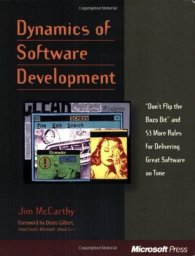
Dynamics of Software DevelopmentMany of these themes are explored in the brilliant and surprisingly nontechnical book Dynamics of Software Development by Jim McCarthy, which I have encouraged every senior executive I have met to read as well as every staff leader I have mentored. In my experience the core issue comes down to learning how to build a consensus, understanding that consensus building is not polling or voting or majority rules. Product development is an expertise, like any other profession. Many individuals can learn to do it adequately, but few can do it extraordinarily.

Look at some of the new wave of great companies and you see the top-tier of product development pros at the helms: Mark Zuckerberg, Reed Hastings, Elon Musk, Reid Hoffman. Of course those are all CEOs of substantial, important, disruptive companies and they are not available for brand turnarounds at internet companies on the rebound, but the question remains, are the people being put in charge of turnarounds somehow similar in nature and characteristics to the great leaders of product development? Are they able to articulate a vision around which people can rally willingly and with trust? Do they listen to a multitude of opinions and then make decisions that incorporate feedback because it is critical, not because it represents a political agenda? Do they have good taste, and can they see beyond the state of today to leapfrog a competitor with perhaps something that didn’t do well in a focus test? Have they built a process in their environment where good work can shine and fast iteration can overcome mediocrity in rapid succession?

Consensus is an astonishingly complex concept; it is not at all compromise. It begins with vision, It is evangelized through leadership, It becomes stronger through group participation and feedback, but it is guided to completion by the same vision and leadership from which it emanated. Consensus goes off track when a leader feels for whatever reason that bits of all contributions most be included to create the consensus, the proverbial camel with two humps. That is wrong, because all comments and critiques will not be right if breakthrough products are your goal. Group participation is a must to achieve organic buy-in, listening is a must for a leader to bypass being feared as a despot, but for great product development to triumph, a vision must remain strong, pure, unique, original. That can never be taken for granted, and everyone on a team will not always be happy at every twist and turn. Yet if you have ever had the privilege of working on a world-class, game changing product, you know that most sins are forgiven when it all comes together through good process, and it does not look anything like the system of checks and balances we see in representative government.

Product development is driven by a different motive set, of creative destruction and inspired disruption, a high stakes arena where often winner takes all, second prize means you go home. Democracy does not work there, and democratic compromise is not workplace consensus. Show me a great product, and I know you will find iteration, but I bet you won’t find haggling.

Vision is what launches a brand. Vision will always be key to reinventing a brand. Process is the key to translating ideal vision into working reality. Consensus is the element of process that gets everyone on a team to remain part of the team, because success is owned by the team, not by its individual components. Get most of that right and product development has a fighting chance, and so might reinvention.

Fleeting Moments in iHistory

Why don’t internet brands make comebacks?

myspaceWith the recent attention on onetime market leaders AOL, Yahoo, and MySpace to inject new creativity into their platforms, I have been talking with a number of people about why this notion isn’t business as usual, with the expectation that success is much more probable than unlikely. We are so quick in the internet age to exchange snarky remarks about last year’s fading nameplates, as if it were all but inevitable that a fallen giant cannot get up and march on. Why?

Well, aside from our gossipy predisposition to critique, there is a good reason we take a skeptical point of view about internet brands that have seen better days—in almost all cases, those were their best days. Major turnarounds don’t seem to be the norm. Sadly, they don’t seem to be out there much at all. We can point to several works in progress where noble efforts are underway, but we can’t really write a business school case study on a revamp that is making history and ripe for the textbooks.

Although this is reality, it does not make sense, certainly not good business sense.

Most traditional brands go through life cycles: they are cool for a while, then something inevitably goes wrong—operational mishaps, disruptive entrants, or market forces—then visionary management attacks the problem and turnarounds do happen, sometimes monster turnarounds. Think about what happened with the rise and fall and rise of Disney, the same but even more so at Apple, the customer win back at Coke after the public rejection of new-Coke, multiple cycles up and down at Sony, the same to a lesser extent at MTV. All of these instances gave management—often new management—a starting point for the very real consideration of turnaround plans. Management carries out the traditional SWOT (Strengths-Weaknesses-Opportunities-Threats) analysis, and the discussion centers around how probable the turnaround plan under consideration might be, not a passive discussion of should we bother. You always bother.

Look at what happened at the Wall Street Journal—newspapers have been pronounced on their way to the graveyard, but the brand has never been stronger and circulation is growing on multiple platforms. That is giving the New York Times hope, the Los Angeles Times as well. You always try because the asset you have is too valuable not to try. CBS, NBC, ABC, HBO, they all have good and bad seasons, but you don’t think about walking away after a bad season. Look at MSNBC, how it struggled out of the gate, now it has an identity. Sticking with an established beachhead can work, surely not all the time, but there are so many examples where the uphill effort is proven to be worth it.

Like internet brands that have enjoyed success, non-internet brands once in the limelight come to the outset of a turnaround with some remaining loyalty, mass reach, measurable unaided awareness, and some core value proposition. The fact that tastes have changed or tactics have failed doesn’t mean you have lost everything; you just have a lot less of it. You have something to work with, so you don’t walk away. Your investors would not be pleased with those kinds of write downs.

Let’s think about the dotcom bubble and all the brands it birthed, starting with the portal wars—Excite (then Excite @Home), Lycos, Looksmart, Infoseek (then Go.com)—they all had huge followings! Now they are answers to trivia questions. What about Friendster, eToys, Netscape, NeoPets, Encarta, GeoCities, Pets.com, Webvan? These were all massively attended internet destinations, great names with tremendous followings built on innovation and creativity. Was there really nothing better to do with their identities than turn away?

I started to wonder whether our relationship with brands today is somehow different from our relationship two, three, four decades ago. Were we somehow more willing to give brands a second chance then that we are not now? Is this generation of consumers somehow wired differently? Have we come to a new understanding of inertia so that once cold something must stay cold? That would have been an easy answer, but one trip to the Apple Store will change your mind quickly. Spend a little time in the store with the other customers and you will soon be reassured how much a once loved, then dismissed, then reinvented brand can be loved anew. Ask tweens about Disney Channel, which they never would have been caught dead watching a generation ago, but now it too has been reinvented to become a trendsetter.

Brand laws may evolve, but they haven’t died.

What seems most ironic to me is that when you look at the giants of brand reinvention, the core turnaround strategy is not financial engineering, but rediscovery of the company’s roots in innovation. Disney expanded its theme parks, its own hotels, rebuilt its animation efforts, created the Disney Store, and rode a wave of home video before acquiring ABC and later Pixar and Marvel. Upon the return of Steve Jobs, Apple pioneered the iMac, then iTunes, then the iPod, then the iPhone, then the iPad, all the while building out the Apple Stores. Microsoft from a standing start entered the entertainment world with Xbox, as Sony had done prior to that with PlayStation. Clearly these involved massive investments, but they were bets on products and services, new ideas from talent and passion within the company.

Can we imagine a day when Google, Amazon, eBay, or Facebook are no longer top of mind with consumers? What about Netflix, LinkedIn, or YouTube? If history is a guide, it is entirely likely one of these or another equally strong internet property will fall out of favor. Are we likely to see it left to harvest? I would bet 100% the answer is no. Reinvention will be the order of the day, and revitalization will follow with new products, new services, and creative marketing to support those initiatives, no different from the offline world.

Internet brands are born of talent and passion—they are the very picture of innovation. So why if they can be invented with innovation can they seldom seem to be reinvented with innovation? Is the answer to be found in independence vs. acquisition by an umbrella company, where founding talent departs and corporate bureaucracy takes over? Possibly, but that seems more like an observation to me than a fait accompli. Just because a young company is bought on the way up or down doesn’t mean it cannot survive a downtown. The question has to be what is being done to address the downturn. If the downturn is being addressed through a product strategy with talent and passion, there is every reason to believe a new vision can have success. Just because it hasn’t happened doesn’t mean it won’t happen. We all have reason to want it to happen, because that creates more opportunity for the industry and sends the right message to customers, that we do listen to them and change can happen when we are serious about it.

Optimism as a driving force is always good. The change that happens in the analog world will translate to the digital world. When a once adored brand is down, root for reinvention.