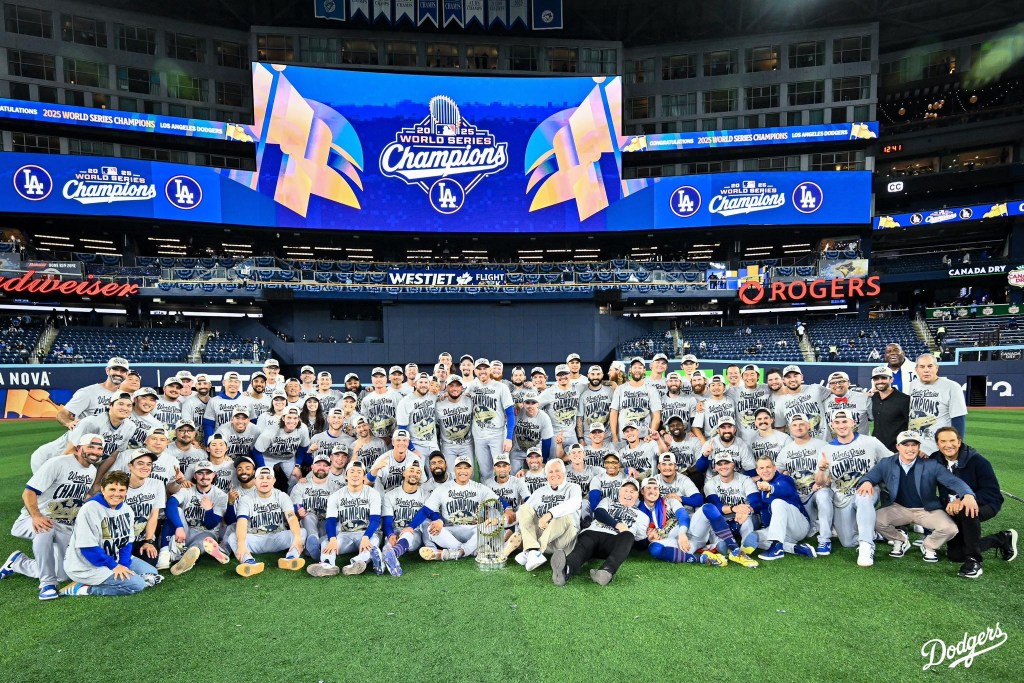
World Series Reflections: 2025 Edition

You might have noticed I’ve published fewer blog posts this year. The political climate has made it hard to write about things that seem trivial in comparison. I’ve found it difficult to comment on news of the day without adding divisiveness to the national dialogue, yet unsettling to try to ignore it with distanced topics. I suspect I’ll resume my regular cadence at some point. I’m not sure when, but I will remain at the keyboard infrequently as my DNA requires.

You might also have noticed that the Los Angeles Dodgers just won the World Series for the second year in a row. That is another infrequent happening, and while perhaps not life-changing, joyously worth a few comments from a devoted fan.

The entire MLB postseason this year was filled with unpredictability. The World Series was a fitting final act to that rollercoaster, with an 18-inning marathon Game 3 and a fought-to-the-finish Game 7 that went down to the last swing of the bat. I won’t recap the play-by-play, others have done that with endless detail, but I will say it was a game that turned on both the performances of superstars and journeymen.

That’s one of the things we love about baseball. Any team can beat any other team on any given day, no matter how good or bad. Chance is always at play. A ball can literally get stuck in a wall crevice and change the outcome of a game (it happened in Game 6). A series MVP like pitcher Yoshinobu Yamamoto can demonstrate consistent excellence on the mound in the clear sight of Sandy Koufax, or a little-known infielder with heart like Miguel Rojas can come off the bench and tie a game that seems all but lost.

Impact can happen at any moment from any player. The game can seldom be predicted.

What does this innocent children’s game played by highly trained adults teach us? We learn from the applied metaphor of baseball that you always play hard to the end. Resilience is your heartbeat. It pays to be indefatigable. You never give up. Never.

Baseball is so many things in the mirror of life. It is the ultimate combination of athleticism and strategy, training and statistics, physical readiness and endless number crunching. It is a game of mistakes — the only sport that counts them on the scoreboard. It is a game of overcoming failure, where a player who gets a hit 2 out of 10 times at bat usually gets dumped, and a player who hits 3 out of 10 often will be paid millions of dollars — crazy many millions of dollars. Unless you are a pro, you’ll never see a 100 mph fastball whip by inches from your body. In fact, the pros can’t see it either, but sometimes they time their swing right, make contact, and put it in the outfield stands.

I had hoped to see the Dodgers win the World Series at home for the first time since 1963. Not only didn’t that happen, but we lost both games I attended with my brother, who was quite the ballplayer in high school and college. So was my dad, who couldn’t attend this year, but texted me at every key moment with his coaching suggestions. I never had the talent, but curiously, I was pretty good with the numbers.

When we lost both those games, I thought of a marketing idea for the front office: how about they give us a 5% rebate for every run we lose by? So if we lose 6 to 1, we get 25% of our ticket price refunded. This would just be for the wildly overpriced World Series tickets. I’ll be sharing that concept free of charge on my annual season ticket feedback form. I don’t expect a response.

The two games we lost at home were more than offset by the final two games we won on the road. The drama of those two games would make for an Academy Award winning movie no matter who won. Note to Kevin Costner, Redford is unavailable — do you have one more baseball epic in you? And who would you like to play?

Hats off to the Toronto Blue Jays, who have waited since 1993 to get back to this big stage. Their ball club oozes talent, from the future Hall of Famer Vladimir Guerrero Jr to the wild ascent of pitcher Trey Yesavage from Single A minor league ball to triumph in the World Series seven months later.

The Dodgers magical starting lineup — Ohtani, Betts, Freeman, Smith, Muncy, Edman, Teoscar Hernandez, Kike Hernandez, Pages — will live in our imagination with most returning for another season. We also witnessed the impossible elegance of an unknown reliever in Game 3 named Will Klein, and in that same game the single inning bridge of the departing great Clayton Kershaw. Manager Dave Roberts made a number of gutsy, counterintuitive moves throughout the series that could have gone either way, but at last the risks played in his favor.

Maybe it will be enough for Costner to make a cameo, a lot of good picks there. AI can help with the aging thing.

It’s all one for the storybooks, but I’ll close with a quiet moment that summed it up for me. When I arrived at the entrance gate for Game 5, I said to the friendly parking attendant I see all the time, ”I’ll bet you’re sad it’s the last day of the season here at Dodger Stadium.”

”What do you mean it’s the last day?” he replied. “We have a parade next week. We’ll all be here for that.”

We had lost the game the night before and the series was tied at 2-2. There was no question in his mind there was going to be a parade. No question whatsoever.

Resilience to the end. Hope in the face of adversity. Optimism facing inescapable, ceaseless competitive resistance.

As Bart Giamatti wrote so eloquently about the game long ago, “It is designed to break your heart.”

Not this time.

Win or lose, this is the game we love.

________________________________________

Photo: TORONTO, ONTARIO – NOVEMBER 2: World Series Game 7 between the Los Angeles Dodgers and Toronto Blue Jays at Rogers Centre on Sunday, November 2, 2025 in Toronto, Ontario. (Jon SooHoo/Los Angeles Dodgers)

Finding Firmer Ground

As our nation approaches another birthday, I find myself like many Americans feeling unsteady, shaken, and increasingly uncomfortable in holding onto a sense of connection to beliefs I never thought could be at risk. Shared values are essential to me, as is the ability to build consensus on difficult issues and a fundamental acceptance of diversity. A few critical points at the moment are eating away at me.

Respecting Secular Differences

The separation of church and state is something I have always believed cannot be denied in our nation. If this pillar falls, the rest crumbles with it. Of course, I know not everyone believes this, but I always thought the majority would never abandon it. Now I worry it might only take a cleverly constructed minority for it to no longer matter. That would forever undo the nation my family chose as a place to immigrate to several generations ago and call home. Is it possible today we would not be welcome here?

Thinking Through Laws

Originalism, or the notion that our Constitution can only be applied to the literal text of its authorship some two and a half centuries ago, seems impossibly flawed as an idea. This is a document that from its inception has encompassed the notion of revision as a core tenet of its foundation. It also has been amended multiple times in its existence to correct the injustices it has allowed, unintentionally or in ambiguity. Peeling back complex nuance is as critical to an argument as referencing precedent. Judges and lawyers cite case law to examine the relevancy and consistency of prior rulings, where opinions are molded into outcomes through rigorous thinking. If the U.S. Constitution does not require interpretation in its application on the endless topics it does not specifically reference—including innovations that couldn’t possibly have been contemplated in prior times—what is the purpose of higher courts?

Growing with Technology

Technology continues to advance exponentially at a rate that consistently outpaces our ability to understand its implications and effects. Without a nimble, advanced, multifaceted framework to consider legislation around innovations that previous generations could never have imagined, we will find ourselves acted upon by invention rather than fostering wise guidelines for incorporating discovery into our everyday lives. Think ahead another hundred years and try to envision what’s coming. Now try to envision how we will create daily norms around incorporating scientific and engineering achievements so far beyond our current imagination we have no concept of how we will be impacted. If we continue to apply yesterday’s rules to tomorrow’s frontier, we will fail much worse at finding common ground than we are now.

Winning and Losing

My sense is that the heightened divineness so many of us are experiencing is becoming increasingly debilitating. If our notion of winning and losing with each other does not evolve into a more palatable interchange of conflicting concepts, our inability to work through our differences could undermine this great experiment we call democracy. There are always individuals who benefit from pouring fuel on a fire and turning otherwise kind people against each other. We cannot let agendas we don’t share take precedence over the communities we cherish.

As we celebrate Independence Day in the midst of so much turmoil and dissonance, perhaps we should reflect on how blessed we could be if we rediscovered a broader sense of shared values, or at least could approach consensus on addressing our disagreements without knocking each other to the ground in the name of unnecessary polemics.

We can do better. We can be better. The alternative is staying where we are currently stuck, and that does not seem to be leading us to improvement. Commit to clearer logic, expanded empathy, and enthusiastic compassion. Let that be our muse this Fourth of July.

_______________

Photo: Pixabay

Separately and Together

With the holidays upon us and two extraordinarily difficult years behind us, I’ve been reflecting on the impact of long periods of isolation many of us have experienced. Curiously it’s not all bad, because I think we have learned to appreciate the time we have alone as well as with others.

Balance offers us a framework for interpreting our thoughts and actions in a dynamic set of circumstances we can neither predict nor control. Resilience is all about never ceding optimism to defeat, but all of us have a breaking point where too much uncertainty creates doubt in our sense of self and others. I think we need both individual and shared strength to be at our best, and holding onto hope that we can overcome doubt is very much an exercise we pursue separately and together.

As we ready ourselves for another year of daunting and exhausting challenges, here are a few perspectives I’m attempting to balance to better navigate the always unpredictable social landscape:

Separately we study in quiet;

Together we validate the suppositions of that study.

Separately we examine the data collected from our experiments;

Together we wrestle that data into a platform of possible directions.

Separately we read from the infinite library available to us;

Together we exchange ideas about those writings that inspire us to rethink our interpretations.

Separately we meditate and pause to block out compounding noise;

Together we find common ground in agreeing on what is noise and what is dialogue.

Separately we examine our values and define a personal mission;

Together we align our interests and develop a shared vision.

Separately we have control over our time to address personal distractions as they emerge;

Together we temporarily eliminate those distractions to focus on our vibrant interactions.

Separately we find comfort and reassurance in our chosen tribes of like opinions;

Together we break down the unnecessary barriers that fuel divisiveness and obstruction.

Separately we know truth in the privacy of our minds unless we are lazy in inquiry or choose to deny known facts;

Together we openly acknowledge honesty regardless of its inconvenience in recognizing the integrity of objectivity.

Separately we contemplate the complex nature of right and wrong;

Together we form bonds that drive behavioral norms around right and wrong.

Separately we embrace evaluation of our psychological motivations and inescapable biases;

Together we embrace diversity and bring necessary change to the marketplace of ideas.

There is little question in my mind that we need time separately to develop a clear-minded sense of self, purpose, and identity;

There is even less question in my mind that we must regroup together at regular intervals to build dependable teams, functioning communities, and enduring friendships.

_______________

Photo: Pixabay