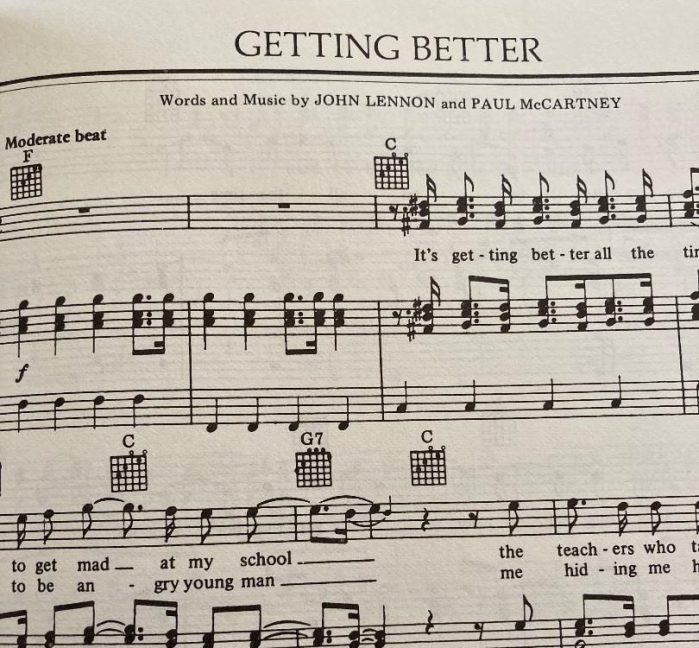
Getting Better


The Beatles sang it. Now I feel it.

I’m not saying things are great. For many they are not. I’m not even saying good. I’m saying better. It’s qualitative. It’s relative. It’s palpable. It’s real.

I don’t care if Trump wasn’t convicted. If 43 U.S. senators want to live with the shame of turning a blind eye to a lying, seditious, self-serving megalomaniac, that’s their lifelong curse. It’s not survival politics as much as it is inescapable shame. The badge of cowardice doesn’t wash off. No bleach will eradicate it.

That cynical, boisterous voice is gone from the White House bully pulpit. That alone makes me feel better.

His Twitter account has been silenced. That’s even better. That’s a real punishment, where we are protected from harm. Not quite a penitentiary, but a fitting alternative sentence, particularly in his mind.

If he tours again on hyperbolic rhetoric or creates his own “alternate facts” media network, he’s sectioned off. We can ignore him. If his followers want to adore him they can have that space in obscurity.

Our new president is sane. Joe Biden is thoughtful. He reads, listens, and takes advice from subject matter experts. He reconsiders his positions. He is immersed in dialogue, not monologue.

He’s reversing the damage. Climate change. Environmental justice. Immigration and border normalization. Broader access to healthcare. Global wellness as a shared concern.

Economic compassion. Sustainable job creation. Sensible credit and finance policies. Respect for our allies. Clear, coherent, calm lines with our adversaries.

Cabinet secretaries are taking shape with gravitas, conviction, relevant experience, and an emphasis on character. They will likely serve without unnecessary drama and ridiculous turnover.

Mostly the voice of government is quieter. The tone is softer. It is moving into the background so we can focus again on our lives, our businesses, our daily routines, short-term and long-term planning.

Science is science again. Facts are facts again. Fake news is fake news again.

Journalism is not the enemy of the people. Hard questions are the safeguard of our democracy.

The notion of any potential sympathy for white supremacy or xenophobia has been erased from the office of the president. To the extent there was any ambiguity around tolerance for racist acting out, it is clear that it will be prosecuted.

Those who participated in the violent January 6 insurrection are being indicted, tried, and convicted. Aside from their cheerleader-in-chief, they will be sentenced and go to prison.

Unity is an inspiring ideal on the table. It is noble to challenge the nation to come together and address our problems. It is a lofty ambition. If the choice has to be between unity and sanity, I’ll take sanity.

Covid-19 vaccines are moving into the mainstream. By midyear, we should have one if we want it. This human suffering and loss of life will end.

Optimism. Pragmatism. Confidence.

Empathy. Humility. Decency.

Trust in words. Belief in promises. Not perfect, but directionally agreed as aspirational.

Blood pressure is down, at least mine. Cortisol levels are decreasing.

Most of all, we are rediscovering honesty. The blatant, unending lies have got to go.

We still have an insurmountable way to go on income inequality, civil rights, Black Lives Matter, hunger, homelessness, all of the endless maladies that divide us. If we can admit that with candor, we can commit to priorities of positive consequence.

We are regaining freedom. We are regaining quality of life. We may be inching forward, but we are off our knees.

The republic has survived. It was a close call. If I ever did, I will never again take democracy for granted.

We are slowly, deliberately healing. That’s what needs to happen. That is progress. That’s what it means to get better.

We are getting better. I absolutely believe we will get even better

Getting so much better all the time.

_______________

Photo: Beatles Complete (1976)

Unfit: A Memo


TO: DJT, POTUS

FROM: Ken Goldstein, Author & Businessperson

RE: The Trump Legacy

SUMMARY ASSESSMENT:

You were unfit to hold the title of the executive office you won in election.

You were unfit to issue executive orders empty of study and laden with self-interest.

You were unfit to appoint cabinet officials whose job it is to challenge your opinions.

You were unfit to seek loyalty from the subordinates you bullied.

You were unfit to be seen as a role model by children in homes and classrooms.

You were unfit to talk of family values, ethical mandates, or moral imperatives.

You were unfit to order military action or report on its efficacy.

You were unfit to lay a wreath at Arlington.

You were unfit to represent our nation in state visits or international forums.

You were unfit to offer comment on science, health, or climate change.

You were unfit to speak of business norms or effective negotiation.

You were unfit to hold authority in the age of “Me Too” reform.

You were unfit to broadly attack our free press as perpetrators of fake news.

You were unfit to demand intellectual credibility when you lied consistently without regret.

You were unfit to be taken seriously as anything other than a threat to world stability and security.

You were unfit to embrace the gravitas of the immense power you commanded and the lack of humility you celebrated.

CORRECTIVE ACTION:

We will heal while you are mired for the rest of your years in shame.

We will recommit to values that embrace compassion and empathy.

We will again celebrate learning and understanding, particularly in matters of science and empirical knowledge.

We will rejoin the community of nations in saving our planet.

We will address income inequality.

We will recommit to healthcare justice.

We will acknowledge the safe haven of asylum and treat immigrants with dignity and kindness.

We will welcome the stranger.

We will not viciously insult distinguished participants in our democracy whose views reflect diversity of thought or background.

We will not embrace humiliation as a strategy to undermine those with whom we may disagree.

We will appreciate journalism and distinguish facts from dangerous manipulation.

We will reject the cynicism of pattern lying for convenience.

We will never forget the hardships we suffered under your fragile ego.

We will face the future with courage, hope, and love.

We will make our nation appropriately great again.

We will let time address your place in history.

_______________

Image: Pixabay

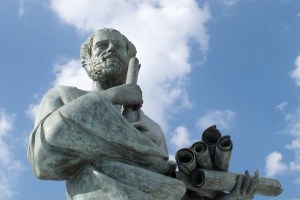
The Study of Philosophy

With all of the ways one could spend four years in college, why would anyone study philosophy?

It’s impractical.

It’s largely self-serving.

Given the vast syllabus of reading necessary to be even modestly well versed in both Eastern and Western thought, there is terribly little material one can cover in such a short amount of time.

It makes no sense to absorb oneself in such an esoteric endeavor with such thin coverage and so little quantifiable value.

It’s an expensive way to squander time, and even harder to explain to those helping pay for it.

Yet I did it, albeit about three and a half decades ago. Truth be told, I still spend unreasonable amounts of time delving into such curious texts as Kierkegaard’s Either/Or and Sartre’s Being and Nothingness.

Why?

Why Then and Why Now are two different things. Let me try to begin with a justification, and then tell you how it has helped me to be better in business, better in service, better in life.

Philosophy is mostly about reading literature, but not the fun stuff. It’s mostly non-fiction, and it’s mostly argued opinion, if not conjecture. There is some history and an occasional parable, but mostly it’s very dense expository in translation. Occasionally you get to drill into something quirky and theatrical like Beckett’s Waiting for Godot, but that’s a tangent, not core curriculum. I mostly focused on the Western canon, so that means works originally composed in Latin, Greek, German, French, and Russian. The translations are often as head-scratching as the source texts.

From the middle ages to the Renaissance in Western philosophy, there is little differentiation between theology and philosophy, so if you don’t want to read about God, this is probably not going to be your thing. You can reject faith later as is often the tradition in modern existentialism, but you have to read a lot about it to reject it comprehensively. Faith is a subject of mainstream devotion and much conflict in our culture. It’s worth learning about it, regardless of what you choose to believe.

The tension in philosophy between quantifying the physical world and attempting to explain metaphysics is persistent and unresolved. Logical argument as a discipline embraces mathematics until calculations outreach contemporary science, forcing abstraction onto problems that later generations will solve. Laws, ethics, psychological motivations, justification for conflict and its resolution, and even aesthetic judgment all prove evolutionary. What is certainty at one time is speculation in another.

Rejection, revision, and reform are the guiding constants of substantial ideas. It’s all quite messy, contradictory, and exhausting.

Philosophy for me as a young person became a passion of personal growth, self-realization, and academic inspiration. It was helpful to me that it was mostly non-emotional because I was also a student of the arts, which were emotional. I needed the balance. I needed the complementary discipline. I needed to be satisfied that hard questions were worth attempting to answer, even if those who answered them began by rejecting the last person who tried to reject them. Somehow that all seemed progressive and appealing to me.

I also managed to convince myself that the power of logic was broadly applicable in almost any field of inquiry. At the very least I would find the structure of articulating an idea useful in dramatic storytelling. While it might not have seemed obvious or even apparent to me how that could be put to use in purchasing food for consumption, I had faith I would figure it out at some point.

Ah, faith—it surfaces in the least likely of circumstances.

There was also this quintessential challenge from Socrates in Plato’s Apology:

“The unexamined life is not worth living.

Those words messed me up because I took them seriously. I even wrote and directed a short film in college specifically about the reincarnation of Socrates in modern times to make this point. It was called Apology. It was supposed to be funny. It wasn’t, but the dialogues of Plato became so ingrained in my consciousness that I had to give it a try.

Failure came early and often after that, but with much clearer reason.

That was Why Then. Let’s cut to Why Now. Yes, there actually is a timeliness to all this.

Our next presidential election is on the horizon. A lot of awful stuff has happened since our last presidential election. I’m upset. I’m more than upset. I’m baffled, befuddled, and out of sorts. Our nation may never heal. I doubt we will get over these scars in my lifetime.

Philosophy remains my comfort zone. It’s a place I go to make sense of things that do not, will not, and perhaps cannot make sense. I wrestle with this all the time. It does not immobilize me. I get things done. To my surprise, I have indeed learned how to apply logical argument to my work. I use it in storytelling and even find ways to wind ponderous floating into the plots of my novels. I also use logic to make arguments in business—in sales, in legal, in coaching. That’s become a byproduct of philosophical usefulness. The core practice is now about coming to terms with the absurd.

I’ve heard all the rhetoric about how our president got elected, about somehow appealing to a forgotten middle class. He has never acknowledged income inequality as one of the defining issues of our generation, never displayed any evidence of empathy or humility, yet he declared himself the champion of hard-working people authentically in need of a break. Those voters may have been duped, but he is an absurdity, as is their loyalty. Our embrace of ignorance and authoritarian mindlessness is absurdity. I use philosophy to live with the absurdity. As long as I am wrestling with difficult ideas, I am convinced the wrestling matters.

Where there are ideas, someday there will be solutions.

The unexamined life is not worth living.

Why are we here? Why is there consciousness?

To do this hard work.

To self-define in the name of combating the absurd.

To commit authentically to making that which is bad better.

Might there be such a thing as Applied Idealism? It’s a counterintuitive notion, difficult to contemplate certification, but spiritually tempting. Samantha Power grapples nobly with reaching for a more attainable abstract in her new book, The Education of an Idealist. It’s comforting to know we are not alone in our outlandish aspirations.

When I envision structures of evaluation, I often discover that the separation of thought and action is at best temporary, if not arbitrary. Logic does not exist outside a problem; it is embedded in the problem. Ethics aren’t distinct from rules and laws; they are expressed in the adoption of rules and laws. Pragmatism does not have to be isolated from hope. When I contemplate a model of assessment and apply it rigorously, I can be held in check by obstruction, but I can’t long be fooled.

As long as I can study, I can stay a fighter. As long as I can delve into the abstract, I will always have more stories to share with you. Once in a while I may even get you to chuckle. That’s when I know your mind is opening and perhaps ready to absorb something new.

In the end, is the study of philosophy a tragic waste of time? I guess for many that might be a fair conclusion. I’ll never see it that way. I see it as vital. I see it as necessary.

Stay tuned to this channel. There’s a lot more philosophy ahead. Considered yourself warned. Or alerted. Or ignited. Ideas are always free. What we do with them is seldom without cost.

_______________

Image: Pixabay

Are Americans Happy?

Uber drivers can surprise you. They can shake up your thinking. They can get you to pause and reflect differently on the day.

A recent early-morning haul with an Uber driver to what I knew would be a long and unpleasant meeting did just that for me. The driver was an Ethiopian immigrant who had been in the United States for about a decade. He and his wife had come here for a better life. His two children were born here.

At first he was quiet, presuming I didn’t want any conversation at this hour. When the freeway traffic slowed our progress, I started to draw him out a bit. I was glad I did.

His basic sense was that America was filled with unlimited opportunities for anyone who wanted to work hard and apply themselves. The ability to make money here—legally and with relatively few logistical obstacles—was virtually unlimited. He actually loved being an Uber driver the past five years. He had control over his time, could spend time with his family, and while the income he earned was modest by American standards, he felt good about the quality of life it allowed him compared with his earlier years in Ethiopia, where money and opportunity were scarce.

What he didn’t understand was why so few Americans he met were happy.

To the contrary, he found most of the Americans he encountered unhappy. The people who rode in his car, no matter how well dressed or where they were going, largely seemed unhappy. The people he saw shopping in WalMart, with all the abundant product offerings on the shelf at such low prices, seemed mostly unhappy. When he took his children to school, which was free, most of the children and parents he encountered seemed unhappy.

He wondered why.

While he wouldn’t trade his life in America for any chance at a permanent return to Ethiopia, he shared that in his younger years, whenever he walked down the road, he would smile broadly and wave hello to everyone he passed, known to him or not. He said he tried that when he initially came to this country, but people looked at him like he was mentally unbalanced, so he stopped.

He told me in his village if someone didn’t come out of their home for a few days, it was normal to knock on the door and see if that person was okay. If they were sick, it was normal to ask if they needed anything from the market and to get it for them without asking in advance for payment. He said to do that here might land him in jail.

He told me when anyone in the village had any good fortune, the entire village would celebrate, and the person who enjoyed the good fortune would be predisposed to share it in small ways without anyone asking. He said when he moved into his current neighborhood, the advice he received from previous immigrants was to keep to himself, let neighbors be strangers, and not to expect to give or get much of anything from strangers.

His conclusion after a decade in the United States was that it was indeed a rich nation of financial opportunity, but with financial success of any level, happiness was not part of the deal. His promise to himself was to put happiness first, and anytime financial gain would compromise it, to put the need for joy above the need for more income.

It was a curious but not unfamiliar conversation that served as an ironic preamble to my next eight hours in a conference room with extremely large numbers being floated around various outcomes to a dispute, and not a single person smiling for the entire day.

I don’t actually think about this a lot, because I haven’t been taught to think about it a lot. I have been taught to work hard, to compete, to give my all at all times, to be respectful of the law, but to be wary of all opponents who might unfavorably tilt the apparent zero-sum game of financial haggling.

I do agree there is something very American about this. We were a country of underdogs that became a nation of global leadership. There is a Puritan work ethic we instinctively embrace that dates back to the first freezing winters of our original colonies. Sacrifice for the future is a mostly shared American value, and our popular literature seldom misses a beat in reminding us that winning is everything.

For many Americans, winning is who and what we are, what we aspire to be, and its cost is a necessary evil, a byproduct of the commitment it takes to be the very best at whatever we set out to do.

Are we happy? I am sure many of us are, and my driver from Ethiopia just hasn’t had the chance to meet you if you are.

It may be worth considering some mounting evidence to the contrary.

We are approximately 5% of the global population.

We generate more than 20% of the world’s total income.

We consume upwards of a quarter of the world’s natural resources.

That is a disproportionate share of global wealth that should be making a lot of people happy.

Our citizens own 40% of the world’s guns.

We consume 80% of the world’s opioids.

We incarcerate 25% of the world’s total prison population.

We have over 1000 active hate groups whose only point of validation is to buy into the lie of their ordained genetic superiority.

Does that sound happy?

No matter what we have, we seem to want more. We are a consumer society. Marketers like me helped make us that way. The problem with consumerism is that it has no logical end. If you have an antiquated iPhone 8, you are meant to want a reconceived iPhone 11. You’ll stare at it just as much, but it will have all the new features you think will make you happier. The stress created by having to pay for it is simply a factor of the replacement value.

Although we have all that wealth collectively, we embody income inequality almost as a leaderboard to remind us of the winners of the zero-sum game. We invented the 1%. Instead of trying to work it toward 10%, we are working toward 0.1%.

Too often I think we forget that we weren’t always this prosperous. Prior to the 20th century, we were a nation that barely survived its own Civil War, the bloodiest conflict in American history. We managed to prevail from two subsequent world wars in part because our continental homeland was not invaded.

We emerged after the Second World War as an industrial power with disproportionate military might and a shared conviction to democratize individual earning power. We enjoyed enormous quality living benefits in this brief window that globalization is now spreading more evenly around the planet.

Any notion of this as entitlement is ill placed. We were clever, innovative, opportunistic, and hard-working. The stars lined up behind us. The turnaround in our fortune was epic. I wonder what we really learned from that unparalleled shift in fate. Humility doesn’t seem to make the report card.

We discovered and celebrated optimism as core to our shared values, but did we protect the essence of its desired outcome—the pursuit of happiness?

I don’t see people in public places smile a lot, or visit the neighbors they don’t know, or wave joyfully to strangers on the street. I could be a little isolated, and I am sure there are many of you reading this who will disagree. If you are surrounded by happy Americans, do you think you are the norm or exception?

Maybe the notion of being happy is the problem itself. Perhaps it is antithetical to our nation’s DNA. If we presume that’s the case, and most of us aren’t going to be truly happy in America no matter what we achieve, perhaps there is another aspiration we can embrace.

Instead of trying to be happy, which is a long way to reach from our present core, maybe we can just be more appreciative of the opportunities around us.

I’m not suggesting a Pollyanna happy dance, given the vast discrepancies in our economic and social culture. I’m wondering if it is possible that, like the Ethiopian immigrant I met, we can identify a perspective around an appreciation for whatever benefits might be coming our way.

It could be as simple as relying on the descriptor “more”that we can be ever so slightly more appreciative of what we have and still keep grinding away at the hardships of our reality. The ramifications around empathy, privilege, and life satisfaction would seem unlimited. We might even begin to understand the inescapable realities of globalization.

Is it possible that Americans can be more appreciative?

I really don’t know. I think I’ll ask my next Uber driver.

_______________

Photo: Pexels