What Does Winning Look Like?

If you’ve ever been in a planning meeting with me, you are familiar with this question: What does winning look like? This is how I like to frame decisions around initiatives we are considering. If we can define success in advance, we will know if we achieve it. If we have no idea what winning looks like before we commit resources to a project, how do we know if it was worth it once we deliver the work product?

We all know what winning looks like in sports. If one team has a higher score than its opponent, that team wins. Simple enough, but is it also winning if there were so many injuries in the latest game that half the team can’t play in the next game? What if the team’s coach coach delivers the win, but on a series of controversial decisions that damage team morale for the rest of the season? What if someone cheats? Some of winning is straightforward, but not all of it.

Let’s consider a working example in business.

Let’s say we have an idea for a new set of features we think we want to create for our e-commerce platform. One way to decide what winning looks like is a simple ROI (return on investment) calculation. Suppose the project cost is a million dollars. The first thing we want to do is get back that million dollars through incremental profits. Remember always that revenue is not profit. We have to take all our fixed and variable costs out of sales before we achieve a contribution to earnings. A million dollars of revenue does not pay back a million-dollar investment, but if our contribution margin on those sales is 20%, then we need an incremental $5m of revenue to produce $1m of incremental cash (presume that general and administrative costs are unchanged to simplify things).

Let’s say then we’ve articulated the minimum payback to break even we need on $1m of investment is $5m of incremental sales (that is, revenue we would not have received without the new initiative). Of course, no one wants to break even in business, we want a multiple of that investment back. Do we want 5x, 10x, or more? A lot of that depends on the scale of the business, but let’s say we want 5x our investment to call it a win. That’s $25m of sales generating $5m of cash for a 5x return.

The next question we might ask is how soon do we want that return. Some of that will depend on the numerous initiatives competing for investment. If two potential initiatives are evaluated to deliver the same 5x return, but one can do it in six months and one can do it in a year, I’d say we go with six months. So the cash we produce is important, but so is the time we have to wait to get it back.

Does winning end there? Is selecting an initiative solely based on return on investment and time? Seldom are those the only factors in play. We need to think about the strategic value of our initiative. Does it lift our customer count? Sometimes that is even more important than the incremental cash we are producing, particularly if we are focusing on the lifetime value of a customer. In this case we might set a goal that the new initiative increases our customer count by 5% in no less than a year. If we know what those customers are worth to us in the long run, we might go back and pick the initiative with the one year return on investment over the six month time frame if the additional customers we are acquiring are all the more valuable.

Another factor in winning might be market positioning in the competitive environment. Let’s say we’re convinced the feature we’re considering is something our customers have been requesting in customer service feedback, because no one else does it very well. Winning in this instance might be about acquiring market share above other metrics. When we launch the feature, if we see our online orders increase by 5% while a competitor’s volume stays the same or declines, we might call that winning, particularly if we can translate that gain in market share into higher customer count or improved lifetime value.

The point here is not to enumerate all the ways we might factor winning, but to force a robust dialogue ahead of committing to an initiative that builds a consensus around the work we will do together. If we collect data in advance, set goals for the improvement of key performance indicators (KPIs), ardently debate the relative merits of the various initiatives before us, and then make an informed choice, we can clearly measure the success or failure of the initiative. If we just reach to heaven for inspiration, how can we know if we won or lost?

Wise business leaders know that if we discuss upfront what winning looks like and then fail to achieve it, there is no blame to be assigned. We haven’t failed at all, we have learned in an experiment that mattered and held consequence. The argument is for better process management, to spend the time in advance discussing what winning looks like so we know it when we see it or don’t see it. Failure to invest that time ahead of committing resources to an initiative is indeed a form of failure, even if the initiative happens to succeed (how you know it succeeded when you didn’t address that in advance is another story entirely).

Don’t move forward without deciding what winning looks like. Crafting a thesis of the change you are trying to affect and the benefits you intend to bring establishes a benchmark for measurement. Insisting on this step early in product development will not only improve the odds of success, it will improve the teamwork and ability to share in the success a team creates together.

_______________

Photo: Pixabay

The Difficult and the Daunting

You may have heard recently that Amazon is pulling back a bit on hiring and warehouse space. With all their vast resources in strategic planning, the executive team there overshot on leasing square feet their forecasts no longer support. I suspect they will manage through this just fine in the long run with little impact on earnings, but it is a powerful reminder of how difficult it is to predict future business both when you’re in an up-market and a down one.

We all get this wrong now and again. It’s normal and usually navigable. The problems come when balancing present challenges heavily compromises a company’s future, or betting only on the future sours a company’s current performance to the point where no one cares about the future.

I am often humbled by the nagging paradox of making tough business decisions every day at the relentless pace of 24x7x365. Running a company in response to everyday circumstances in the present will always be difficult, Running a company for an opaque future will always be daunting.

We have to do both well to accomplish our current goals and set the table for the next generation of growth prospects. Favor either the present or the future too heavily and the question becomes whether you want to lose now or later. While that’s not an option any leader wants to consider, if we don’t see the delicacy in how one affects the other, our intentions can be undermined by our outcomes.

We often hear about the pressures of being a public company, how corporate leaders make choices to focus on quarterly earnings from which they financially benefit immediately over building strong companies for the long haul. I do think this happens at some companies where short-term stock performance can dramatically impact executive compensation. Too often those companies fall prey to what Clayton Christensen famously has called The Innovator’s Dilemma and allow their long-established norms of success to be fully disrupted by more nimble competitors.

There’s a more ironic take on this notion, where equity markets sometimes forgive emerging companies for failing to produce earnings at all in the near term in the hope that someday they will have gained so much market share that they will prove invincible. This all-or-nothing strategy has paid off handsomely for companies like Amazon that didn’t produce earnings for years, reinvested heavily in their growth, and today reap the benefits of that bet. Sadly, this example has been exploited by too many newly public companies that don’t even consider near-term profitability a goal, allowing lazy business models to overshadow unfounded optimism that someday their customers will reward them with enviable positions.

A company that bets only on the future, never becomes economically successful, and runs out of cash can be train-wrecked just as decisively as a once successful company that fails to address The Innovator’s Dilemma. If the executives steering either of those failures happen to be selling shares along the way to a company’s demise, a feast of lawyers will follow.

Inflation and rising interest rates make the cost of doing business higher for everyone. We painstakingly decide how much of these costs we pass along to customers and how much we absorb. The benefit of preserving current operating margins is always tempting, but the rewards of long-term customer loyalty and lifetime value speak for themselves. How do we decipher the balance between current and future financial results? Data will often shine a light on the path, but there are no conclusive textbooks with clear answers to these calculations.

It truly is hard to run a company both for today and tomorrow. We have to consider the staff sizes we need, the leases we’ll require, the stability of our supply chains, price elasticity, and the promise of our brands. We also carefully must watch cash flow, our balance sheets, compensation, incentives, technology advancements, and investments in future product cycles. What works today may or may not work tomorrow. It is seldom that what works perfectly in one set of conditions works just as well in another.

There are no perfect answers, but the fluidity of making a decision now for its short and long-term impact usually weighs heavily on those who wrestle with the impossible crystal ball.

Covid-19 has been a good reminder of how difficult and daunting decisions can be. We were all blind during Covid and it was easy to misread fluctuating data. No leader had substantial experience with stay-at-home working conditions. No one knew how long the pandemic would last, how it would impact supply and demand, or how it would impact investor sentiment. If that wasn’t enough of a challenge, most of what we thought going into Covid proved to be wrong, and most of our assumptions about how employees, customers, and investors would behave post-Covid have been equally wrong.

If you want to be humbled, try making decisions that address the unknown with this level of frequency. You’ll likely realize you’re wrong more than you’re right, but the less tangible skill we develop is how to rethink and react quickly when we discover we are wrong. That’s why the rewards for creating a company that is “built to last” are immense, but the odds of lasting fifty years are long.

When it comes time to decide short or long, know you have to do both, and do your best you to keep dialogue and debate flowing among diverse opinions. The decisions we make have an impact we might be able to see today, but unless you know someone who has a gift the world has never seen, we are almost always speculating on the impact a year or more from today. Sometimes it’s decades before we find out if we were right or wrong.

We choose to sign up for the difficult and the daunting. The longer I do this, the more humbling it is.

_______________

Photo: Pixabay

You Call This a Loyalty Program?

Try this episode on for size and tell me how it makes you feel about the brand:

I recently logged into one of my hotel loyalty accounts where I had amassed several hundred thousand points. That is, I thought I did. All my points were gone. Apparently this chain has a policy that deletes all your points if you don’t stay at one of their properties for a year. Did they send me a courtesy email reminding me I needed to stay there toward the end of the twelve-month lapse? They did not.

I called customer service and they recited the policy back to me, willing to say farewell to a customer who had paid the freight to accumulate several hundred thousand points in its loyalty program, just not in the past 14 months.

Then I tweeted my complaint about the forfeited points publicly. A few hours later whoever runs the company’s Twitter account tweeted back publicly that the company was very sorry for the situation and dedicated to my satisfaction. The Twit-master asked that I send a private tweet to follow up, which I did. Then we moved the correspondence to email.

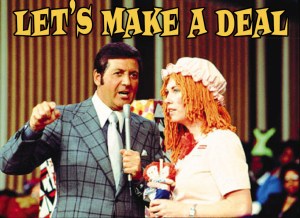
I was then told that the company had a one-time exception to the policy where points could be reinstated, but that had already been done for me approximately 13 years ago. Silly how I could have forgotten their grace. However, they said that in an attempt to reinstate my customer satisfaction, they would restore half my forfeited points now and the other half if I agreed to stay at their properties at least three times in the next six months. I wrote back that it sounded a bit ridiculous to be playing Let’s Make a Deal – Loyalty Edition with them, but I would agree because, well, why not?

To their credit, they did return half my points upon receipt of our “written agreement” in that email thread, and I have booked one stay with them. I just wonder, is this what they really set out to accomplish in developing their loyalty program? Is it a loyalty program at all, or just a rewards program that effectively gives me a rebate on what I spend provided I do it on their timetable?

If you give me a reward for my business, then take it away because I didn’t precisely follow your rules, then give it back conditionally with an expectation that somehow I have become pleased by our interaction, how has this helped me as a customer or you as a business? It’s a quid pro quo. I don’t think a quid pro quo has anything to do with loyalty.

When I think about loyalty, I think about preference. When I think about preference, I think about what brand comes first to mind when I need a particular item or service. I choose that brand for a host of reasons, for the totality of my experience with the brand.

I prefer to fly Alaska Airlines because they tend to treat me better as a human being, so I am loyal to them. I am also a member of their loyalty program, but that has very little to do with my loyalty. The way we interact all the time has to do with my loyalty. There is a consistency in my interaction with their airline personnel whether I am flying in coach or upgraded to first class, whether I bought a discount or full-fare ticket. That consistency is what creates loyalty.

I prefer to shop at REI for sporting gear because they are patient with me when I come to their stores not knowing nearly as much about hiking or biking shoes as they do, and when I leave it is with the right pair of shoes. I am also a member of their co-op because that is required to shop in the store, and I get a member rebate every year, but that is not why I am loyal. I am loyal because when I am on a trail or in spin class and my shoes are comfortable, I remember how great they were about helping me get the exact fit and charging me nothing more for their time.

I don’t prefer the hotel chain that gave me back half my points now with a contingent promise for half my points later. We have a transactional relationship based on price and location. I wouldn’t seek them out. I could, but they have given me no reason. Now when I think of them I think of my Let’s Make a Deal experience rather than any experience staying under their roof. That’s sad.

Maybe the problem is terminology. Maybe there is no such thing as a loyalty program. Maybe they are all just rewards programs masquerading as loyalty programs. That’s kind of a punt when you think about it. We could design a loyalty program that involved every point of customer interaction to ensure your satisfaction, but heck, that would be hard, why don’t you just take these points instead and we’ll play like we’re loyal to each other even when we know, wink-wink, we couldn’t care less about each other. It’s a bed and bathroom and points if you follow our rules, so come here at least every twelve months and someday maybe you can cash in those points for a standard room on the house. Maybe, if we have availability, certain restrictions apply.

I recently attended an e-commerce industry conference where at more than one session I heard the phrase, “There is no customer loyalty, consumers only care about price.” If this cynical statement is true, then I wonder why we have marketing departments at all. Don’t believe it. All customers are not automatons who solely focus on what’s cheapest.

Brands are not dead. A brand is a promise. Brands compete on price, quality, and service. If a company wants my loyalty it is there to be won, like Alaska Air and REI. If a company wants to make it about points and rules, that’s something else, and yes, in that scenario why should there be customer loyalty?

You get what you give. Since you’re selling and I’m buying you get to go first. You want my loyalty, show me yours. You want my loyalty, enter into a brand-customer relationship with me. You want to make it about points, if you piss me off I’ll dump you at the next possible off-ramp.

Loyalty is hard to win. It should be, because it’s valuable. That’s why the great brands think in terms of lifetime value rather than rules. If I have to publicly embarrass you with a tweet to get your attention, you don’t care about me a hoot, especially when you just had me on the phone. Think about that the next time a company penalizes you for breaking its loyalty rules. Those are stupid rules. You don’t need the points that badly, and if you don’t prefer the brand, you sure don’t need its crappy rewards program.

_____

Image: Stefan Hatos – Monty Hall Productions

Leading Teams Toward Success Using People, Products and Profits

I’ve written the words People, Products, Profits (In That Order!) so many times over the years it would be easy to think of them as simply a slogan I use, a catchphrase meant to pique your interest. I assure you this is no more the case than Apple using the words Think Different as a clever tagline. Like the words Think Different, People-Products-Profits is part management philosophy, part rallying cry, and in an aspirational context, part religion. When I invoke these words to set the table for embarking on the outrageous, it is with the full knowledge that I could sound silly, fail miserably, fall on my face, or possibly convince you that relentless pursuit of the extraordinary is within your grasp. That’s a lot to bite off in a very few words. It’s meant to be.

In my new book, Endless Encores, a veteran CEO named Daphne spends an evening talking with an up-and-coming executive named Paul, helping him come to terms with the potential first failure he could be facing following a huge initial success. They are stuck in an airport, passing the hours. She is a leader and he is leader, only at the moment he is too obsessed with his own personal exposure to realize that he is failing to be a leader by trying to duck out of the way of his own mishap. By worrying more about what he has done than what he has learned, he has shifted the weight of his problem from marginal to endemic. In truth, the failure he might be facing is not so much a setback as it is an opportunity. By the end of the story, he has embraced that and reset his sights on the long game.

Save for the guidance from Daphne, Paul might have missed the boat. And the plane. And all that might have been ahead of him in the form of material reward, passionate accomplishment, intellectual richness, and emotional fulfillment. It’s a close call, but he makes it over the coals. You can, too, if either you have a Daphne in your corner and you’re willing to listen, or if you otherwise come to acknowledge your role as a leader is more about the long-term example you set than the specific offering you at the moment champion. One is permanent and tangible, the other fleeting and beyond your control. Where would you prefer to focus?

Leading through People, Products, and Profits means committing to the idea that talent is a priori to all success. This has much less to do with your own talent than the talent you assemble, empower, and inspire. World class products and services don’t create themselves. They are created by human beings, most often high performance teams, and the time you devote to building and bolstering those teams is a direct reflection of your values.

When your team identifies a product concept that is worth pursuing, leadership becomes the championing of execution over the touting of an idea. We can all dream up big ideas, but few of us can bring them to market. Those who can almost invariably need some form of stewardship to hold the team together through unending punch lists of details. If that’s not challenge enough, you can have the best team in the world and the best product in the world, but if your business model is not sensible and doesn’t sustain the enterprise, it really doesn’t matter what you set out to accomplish. A business has to create value, usually measured in the form of profit, and if you can’t lead a team to do that more often than not, you’re not likely to get many chances to stand in the center ring.

The point of the rallying cry is to set a tone of priority, balance, and perspective. Everyone likely wants a business that is profitable, but leaping straight to the outcome ignores the most valuable element in the mix: your customers. An exceptional team that has been well-directed puts the customer in first position, in essence their supreme boss, with the primary hope that if a customer’s expectations are exceeded, that customer can become a customer for life. When we talk about the notion of lifetime value, we are talking about just that: Have we surprised and delighted a customer in such a way that they ascribe emotion to the brand we represent? Will they come back for more with cost-effective prompting, and will they tell their influence circles about the breadth and depth of their fine experience? That’s why a business leader is accountable first to customers, because they hold all the cards, and that’s why when they pursue a business opportunity, they place investment in talent first, product innovation second, and business model third. You need all three, but put them in the wrong order and you are left extracting value from a customer rather than bonding a customer who becomes a partner in creating value.

Yes, you have to juggle three balls at once in sequence if you want to repeat success, and you have to do it over and over. It’s not easy and it’s not supposed to be easy, because if it were, you wouldn’t be worthy of praise or wealth because anyone could do it. Likewise, leadership is a choice. It’s not for everyone. The rewards are far often more intrinsic than measurable, and falling on your face in a public forum is never going to be fun. You will fail. We all fail. If you learn when you fail you will also win. You have to decide if leadership is really something you’re ready to shoulder. If you are, choose your words and the order of those words carefully. The talent around you will only become cynical if you’re insincere and don’t stand for something more than winning right now.

Repeating success is about the journey. Leading is about tone and substance. Projects are always short. Careers can be short or long. The choice is always yours. Your values always matter. If you’re deliberate in determining how you build a culture of shared values, the best around you will always be listening. Stay authentic and their results will surprise you. Those are likely to be extremely pleasant surprises.

_____

This article originally appeared on Leadership Now.

Photo courtesy of Free Range Stock