Brand vs. Direct: Must We Choose?

My distinguished colleague Gene Del Vecchio sent me some insightful follow-up thoughts to my post last week on advertising. Gene’s credentials in this area are much deeper than my own, with more than thirty years of advertising experiencing rising to the level of SVP at the renowned agency Ogilvy & Mather. He is an award-winning expert on advertising research, and also a successful author of non-fiction and fiction books, including the data-driven breakthrough Creating Blockbusters!

Gene’s point was that the distinction between brand and direct response advertising is a label, sometimes artificial and not necessarily useful except by executives managing ad budgets, often on the agency side. As simply stated as possible as handed down by legends like David Ogilvy and Leo Burnett—the individuals, not the agencies—all advertising has a single purpose: to sell products. Image is nice, awards are nice, clever memories are nice—but if the shirt doesn’t sell, it’s a cruddy shirt ad.

Gene summarized his point of view as follows:

The distinction between “branded” and “direct” is a red herring. If I advertise a movie on Thursday, I expect people in seats on Friday. Isn’t that direct? Sure it is. Simply because the time delay was 24 hours instead of 12 seconds, people are likely to say otherwise. These two disciplines need desperately to merge into ONE that both brands and sells. They are kept apart because many clients view them as silos. Adding to this is that agencies often hold these disciplines in two different groups with separate profit & loss responsibilities. Brand account managers at agencies don’t want to give up money to their counterparts in direct, and vice versa. Agencies also tend to have their highest profit margins in television ads, more than direct response campaigns, thus the agency business model with its higher overhead tends to favor the bucket called brand advertising. This is a battle on three fronts: 1) a philosophical battle of what is brand vs. direct; 2) a mechanical tracking battle regarding how to measure the effect of each; and 3) a business model battle regarding how agencies make their money.

Creating BlockbustersGene is a wise and honest fellow. I admire his candor which is firmly grounded in extensive experience. Surely an account executive would argue his or her job is always to do what is in the client’s best interest, but if they are doing what they believe is in the client’s best interest and it happens to be on the more profitable side of the agency’s business, one would have a hard time criticizing that as anything but a win-win. Rather than argue the potential conflict in an agency’s interest vs. that of the client, I find it more interesting to consider whether Gene’s suggestion that the distinction between brand and direct marketing has become anachronistic, and that this is yet another topic where we ought best to Think Different.

Few who have survived long careers in media would argue that brand advertising is meant to do anything other than sell products, and in that respect it has the same intention as direct response advertising. Long before the internet or digital platforms were available, long before the 1000 television channel universe, marketing budgets were allocated by clients as an acceptable percentage of total sales volume, invested in multi-platform campaigns that included TV, Print, Radio, and Outdoor. Sales expectations were set to evaluate Return on Ad Spend (ROAS). The concept of buying a carefully constructed and flexible campaign was investment driven, leading some forward-thinking corporate heads of marketing like Sergio Zyman at Coca-Cola to begin thinking of themselves as CMOs, or Chief Marketing Officers. If funds were invested and returns did not appear, they were accountable, and yes, these jobs have always been volatile. When CMOs turn over, ad agency accounts often come up for review, also a very volatile affair. While some agencies like Ogilvy and Burnett were well-known for keeping clients for ten, twenty, even thirty years, it was not because of Clio Awards, it was because of sales results. Anything less than accountability and ad business would be in jeopardy.

As more technologies became more available to CMOs and award-winning TV commercial directors found paths to becoming movie directors, a notion of image advertising entered the equation—as if to suggest that some advertising was meant to sell and some advertising was meant to make you feel good about a brand. Gene’s argument, with which I concur, is that makes no sense at all. If the advertising does not result in sales growth relatively soon—the car ad putting a perspective buyer in the showroom, a movie ad putting weekend butts in seats— it really doesn’t much matter how people feel about the Chevy brand or the Indiana Jones brand.

The job of an ad is to create action. A nice step in that direction might be a feel-good moment, but without action, no one paying for an ad cares a hoot about ” feel good.” Clients pay for an ad for a reason, and they don’t much care about trophies or “best-of round ups.” If the stuff they advertise is stuck in the warehouse, they are out of business. There are no more ads to buy next year, just burned creditors seeking liquidation crumbs.

At the same time advertising options became more creatively interesting and diverse, direct response mail and television infomercials touted their accountability. You mailed this many pieces, it cost you this much, you got this many orders, your cost per acquisition was at your target, live long and prosper. All of that may have been true, but with response rates worth celebrating at well under 5%, it was hard to argue the same kind of waste identified in TV epic brand spots wasn’t to be found in direct marketing initiatives—if you can get a 5% response rate, why can’t you get 10%, or 50%, or 100%? Why do we have to accept the old adage that in any campaign 50% of your ad dollars are always wasted, you just don’t know which 50% went up in smoke? And why can’t your direct response campaign have a residual brand effect, so that even if you don’t buy now, you might buy later, and if you do buy now, you might remember to buy again later? How do these urban legends become generally accepted principles, simply because they produce positive return on investment, however marginal?

Along comes perhaps the most important advancement in advertising since the thirty-second TV spot—the internet keyword ad generated by search engine marketing—and suddenly we begin touting 100% accountability in advertising. You pick the words you want to buy, you set your parameters for the auction, you pay your bill, and you get your orders. Perfect, right? Well, not exactly. You still pay for a lot of clicks that produce no value, factoring these as negative offsets to the profitable transactions of the campaign, and you feel a little better because you only pay for the clicks, not the impressions. The question is, can you or should you be getting residual brand or feel-good value for these unprofitable clicks, and if you aren’t, can you at least get some residual or byproduct brand value from the impressions that people are seeing even though the are costing you nothing? If you can, you have discovered advertising nirvana, which is precisely Gene’s point on bridging the applied and artificial distinction between brand and direct response marketing. Gene calls this finding the Golden Goose:

The key for both brand and direct response marketing has always been this: SELL IN A BRANDED WAY. TV, radio, print, and outdoor should create an image that sells. Internet clicks should create an image as they sell. That has been a rallying cry at agencies for years. Have they attained it? Sometimes yes and most times no. These two tools should also work in concert, together, as part of an overall strategy, and not thought of as mutually exclusive. The trick is to find the right balance of each, given each brand’s strategic objectives and its consumer’s decision-making process. The blend creates a consumer driven contact strategy, where you cannot tell where brand leaves off and direct begins, because they are part of the same whole.

I like the way Gene is thinking here. I find his approach to be liberating and aspirational. Will it be easy? No, but why should anyone in media get paid for what is easy? Can we get better at what we do and make our tools and platforms work harder for the people paying the bills? We better, or we ought not expect our invoices to continue getting paid. As the world becomes more flat, the notion of separate creative buckets becomes harder to defend. It’s time to be less defensive and get on offense, applying higher level creativity to more difficult problems of client advocacy, focused communication, and customer call to action.

Thoughts About Steve

Steve Jobs 1955- 2011Everyone who has worked around technology the past few decades has a Steve Jobs story. Some have observed Jobs at a distance and felt the impact of his creativity and decisiveness, others have worked with him directly and more explicitly experienced his creativity and decisiveness. No meeting with Jobs is forgettable. Most meetings with him begin with a non-disclosure agreement, and since no one is quite sure of the statute of limitations he expects, I shall tread carefully through this post while still sharing some of my own observations.

So much has been said and written about Steve Jobs in the past week it is almost daunting to try to add to the collection without being redundant. In a recent profile on CNBC Titans, Jobs was portrayed in a balanced manner, fully celebrated as the Thomas Edison of our time, of course not without a few bumps in his long and winding road, personal and professional. The day after the announcement that Jobs would no longer be CEO of Apple, Walt Mossberg in the Wall Street Journal expertly assessed the legacy of Steve Jobs as someone who changed the way we live. Coverage and analysis have poured onto the web from professional and citizen journalists, the very volume of which speaks to the somewhat incomparable significance of his contributions.

My personal experiences with Jobs were mostly tied to the launch of the iMac, right after he returned to Apple in 1997. We had just launched a games label at Broderbund Software called Red Orb Entertainment, and Jobs invited us to be part of his new beginning. Riven: The Sequel to Myst, developed by Cyan Worlds, and The Journeyman Project 3: Legacy of Time, developed by Presto Studios, were both largely created on Macs by Mac devotees, so it was easy and natural for us to get onboard. Everything Jobs promised us happened, from the billboards to the print ads to inviting Cyan President Rand Miller to share in the keynote at the Macworld Expo. The iMac was unique, Jobs’s vision was unique, and he wanted unique products to be associated with its beauty. That was the beginning of Apple’s resurgence, and it was magical.

What was most impressive about the return of Jobs was how quickly he brought the core values back to the company that seemed to have evaporated with his initial departure. Meetings at Apple in the non-Jobs years had become, to say the least, painful. Apple had forgotten what was special about it, that its publishers and developers were a unique bunch, and that fully democratizing the Apple universe would serve no one customer well if the core values of Apple were not embraced. Upon Jobs’s return, those core values returned in real-time and included with stunning mandate:

• Intuitive user interface is not optional. If a customer needs a manual, something is wrong. I remember when we received very first prototype iPod, no one in the house knew what it was, but within five minutes of it landing on our doorstep we had it synched and working with iTunes. How much more intuitive does it get than getting a new high-end gadget that never previously existed and have it working flawlessly without instructions?

• Innovation is meant to leapfrog entrenched competitors. The iPod wasn’t a better MP3 player, it was a new vision of how music could be enjoyed. The iPhone wasn’t a better cell phone, it was a lifestyle device that put a computer in your pocket. The iPad wasn’t a better tablet, it was an all media delivery system that is light, fast, simple, and elegant. If Jobs was going to make incremental change, it would be on later versions of his own products. The products he introduced to market were to be leapfrog inventions.

• Think Different is much more than an advertising campaign. Think Different is an intellectual construct that begins by defying grammar and doesn’t end until we have exhausted elimination of the ordinary. It is sometime said the difference between a cult and a religion is how long a movement lasts, and for many devotees, Think Different is something of a religion. It forces us to challenge ourselves to achieve the impossible, and then when we achieve it, make it look simple to everyone else.

When I worked at Disney, I remember well the weekend we had a staff preview at our new theme park in Anaheim, Disney’s California Adventure. Disney had not yet bought Pixar, that was years away, so the relationship between the companies was quite separate. One of the attractions at the new theme park was a whimsical movie about the history of California hosted by Whoopi Goldberg that delved into what made California unique. That attraction no longer exists, but what I remember most about it was the section on Jobs, largely painting him not only as part of California’s history, but our nation’s economic advancement. The portrait was magnificent, because his contribution to the world through the Silicon Valley miracle was magnificent. It was more than California, it was more than technology, he was settling the new frontier. What felt weird to me was that what I was seeing was indeed history, but it was happening now, current events, a real man and a real life changing the lives of all of us with each new idea and grand leap forward. I never got to meet Walt Disney or Henry Ford or Sam Walton, they were more icons to me than tangible people. Steve Jobs had become part of our lore while he was still young and his legacy was unfolding in our time.

Yet of all the emblematic impact of Steve Jobs, what resonates most with me is what he means to the notion of reinvention. Here is a guy who was driven out of the very company he founded by the very fellow he had invited to help him run it. Had he done nothing else after that event he would have forever been part of the Silicon Valley story. Then he founds another company, then Apple falls on almost unrecoverable hard times because it has lost its way and he returns, embracing that new-new thing called the Internet and helping chart its hockey-stick future. As a sideline, he buys a small computer graphics company from George Lucas and helps guide it to become one of the most successful entertainment production studios of all time.

Like so many others, I am trying hard not to write a tribute, but instead capture the spirit of what the contributions of Steve Jobs can mean to every one of us, whether or not a devotee. The point is that reinvention is possible no matter how hard we fall on our face, and that is a lesson always worth re-learning. Reinvention is not the stuff of storybook fables and pep talks, but the stuff of necessary and vital resilience. We need concrete examples to see that reinvention is possible, that lives and devices and ideas can be reinvented if we have the will and commitment to Think Different.

For me, that is the legacy of Steve Jobs. All that he has accomplished in a lifetime is astonishing, but like his very small peer group of great visionaries who have led our economy forward, it is the abstract notion of reinvention that I see and feel whenever he is present, nearby, referenced, or invoked. No matter how many English teachers correct us, I hope we will never stop saying the words Think Different, attributing them appropriately, and giving all we can to reinvent the legacy.

Product Development is Not Democratic

Following up my last post on the scarcity of successful internet brand turnarounds, I had a number of interesting discussions with colleagues in search of the answer why. While it would be impossible for me to boil that down to a single concept in a single blog post, the common theme seemed to be the extraordinary difficulty in reinventing the key products or services under a once a powerful but now fading brand, such that the new offerings were up to the standards of the original breakthrough experiences.

Digging deeper into this theme of why a brand that was created of innovation could have such a hard time finding reinvention in subsequent cycles of innovation, the culprit fueling failure often found the compass needle pointing at process. Where some form of good process once allowed staggering creativity to flourish, failure to reinvigorate good process most often led to uninspired product development, lackluster offerings to customers, and ultimately a continuation of the downward spiral where a turnaround was the hope. Called out for especially pernicious result:

1) Tepid Innovation—believing that a little idea was a big idea almost in desperation for lack of identifying a big idea. Copycat products that responded to market leaders to segment small bits of their commanding market share consumed energy where market leading ideas remained in small supply.

2) Lack of shared vision—weak leadership failed to articulate a big idea around which teams could rally, so buy-in became compelled rather than organic. Empowering strong leaders to lead is not often enough a company’s core competency, because truly creative rebels don’t want to be managed, they want to be sponsored, so that they can make change happen in cultures that prefer conformity, and conformity is not how you win market share. When the right leaders are chosen and empowered, they can build a shared vision by leading, not managing.

3) Corporate intervention—a young company acquired for its Think Different mentality and bold new ideas becomes indoctrinated in the prevailing corporate culture of the parent, and begins to see the world through the lens of the acquirer rather than for the reasons it was acquired.

4) Lack of listening—there is no longer a measurable correlation between time on the job and quality of concept. The youngest arrival in a company may just have the best ideas, but if there is no forum for real listening and discussion, the most creative voice can be too easily silenced.

5) Marketing/Engineering Wars—rather than partner, the two necessary sides of the winning formula argue for the sake of winning the argument. They forget what it means to win—that their competition works at another company.

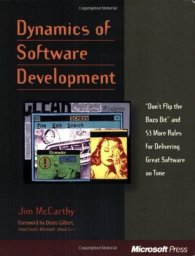
Dynamics of Software DevelopmentMany of these themes are explored in the brilliant and surprisingly nontechnical book Dynamics of Software Development by Jim McCarthy, which I have encouraged every senior executive I have met to read as well as every staff leader I have mentored. In my experience the core issue comes down to learning how to build a consensus, understanding that consensus building is not polling or voting or majority rules. Product development is an expertise, like any other profession. Many individuals can learn to do it adequately, but few can do it extraordinarily.

Look at some of the new wave of great companies and you see the top-tier of product development pros at the helms: Mark Zuckerberg, Reed Hastings, Elon Musk, Reid Hoffman. Of course those are all CEOs of substantial, important, disruptive companies and they are not available for brand turnarounds at internet companies on the rebound, but the question remains, are the people being put in charge of turnarounds somehow similar in nature and characteristics to the great leaders of product development? Are they able to articulate a vision around which people can rally willingly and with trust? Do they listen to a multitude of opinions and then make decisions that incorporate feedback because it is critical, not because it represents a political agenda? Do they have good taste, and can they see beyond the state of today to leapfrog a competitor with perhaps something that didn’t do well in a focus test? Have they built a process in their environment where good work can shine and fast iteration can overcome mediocrity in rapid succession?

Consensus is an astonishingly complex concept; it is not at all compromise. It begins with vision, It is evangelized through leadership, It becomes stronger through group participation and feedback, but it is guided to completion by the same vision and leadership from which it emanated. Consensus goes off track when a leader feels for whatever reason that bits of all contributions most be included to create the consensus, the proverbial camel with two humps. That is wrong, because all comments and critiques will not be right if breakthrough products are your goal. Group participation is a must to achieve organic buy-in, listening is a must for a leader to bypass being feared as a despot, but for great product development to triumph, a vision must remain strong, pure, unique, original. That can never be taken for granted, and everyone on a team will not always be happy at every twist and turn. Yet if you have ever had the privilege of working on a world-class, game changing product, you know that most sins are forgiven when it all comes together through good process, and it does not look anything like the system of checks and balances we see in representative government.

Product development is driven by a different motive set, of creative destruction and inspired disruption, a high stakes arena where often winner takes all, second prize means you go home. Democracy does not work there, and democratic compromise is not workplace consensus. Show me a great product, and I know you will find iteration, but I bet you won’t find haggling.

Vision is what launches a brand. Vision will always be key to reinventing a brand. Process is the key to translating ideal vision into working reality. Consensus is the element of process that gets everyone on a team to remain part of the team, because success is owned by the team, not by its individual components. Get most of that right and product development has a fighting chance, and so might reinvention.

It’s Not Lotto, It’s Life

The Harder You Work, The Luckier You Get
by Ken Goldstein
Eighth in a Series of Ten

The quote in the subtitle above, “The harder you work, the luckier you get” has been attributed to so many individuals it is probably best accepted as a cliché, but since I heard it first and most often from my father, I’m giving him the credit.  I’ll apply another cliché, “minor poets borrow, great poets steal,” so credit here is probably less important than viral sharing, which is the value of any common sense idea broadly distributed.

Yet how common is the common sense in seeking luck by giving your all to what you do? Those seem like different things. Luck is elusive, ephemeral, it may not even exist except in hindsight, as a descriptor rather than a force. Work is what you do, effort that you control, with results that may or may not have the impact you desire based on any number of uncontrollable market forces. You cannot will good fortune anymore than you can guarantee an outcome where you cannot predict and guide any number of moving parts well beyond your scope of influence.

Or can you? Think about this for a moment, the people in business who you would call lucky — do they tend to be lucky once or lucky many times over? You would probably answer both. So let’s toss out the one timers and call them lottery winners, nothing we can learn there except sometimes good stuff happens to both good and bad people, and that’s just it, it happens. Now let’s think about the consistently lucky individuals we see winning over and over, in good times and bad. Are there any consistencies in their actions? My guess is that they may just be working a little harder than their competition, pushing themselves intellectually beyond the obvious tasks that others do to get by, challenging themselves to Think Different and really work a complex set of issues to unexpected outcomes. I am not sure they make luck happen, but they do allow themselves to be in positions where they can be more often than others open to unusual and often positive circumstances. They might be just a little more dedicated than others, just a little more optimistic about creativity as a tool, just a little more self-energized to seize upon an unexpected win scenario when it appears out of nowhere.

Last month in a Wall Street Journal column entitled “How to Get a Real Education,” not less than Scott Adams, the visionary mind behind Dilbert, offered this among his tidbits of advice to college students whom he was trying to give a shortcut to success given his own treks through the school of hard knocks. Wrote Adams under the header Attract Luck:

You can’t manage luck directly, but you can manage your career in a way that makes it easier for luck to find you. To succeed, first you must do something. And if that doesn’t work, which can be 90% of the time, do something else. Luck finds the doers. Readers of the Journal will find this point obvious. It’s not obvious to a teenager.

Fans of popular quotes may hear the echo of Pasteur’s “Fortune favors the prepared mind” in the words of Dilbert’s creator, which simply reinforces the same theme.  Harnessing luck might be akin to catching lightning in a bottle, but how are you going to capture the lightning if you don’t have a bottle ready, and if you aren’t willing to get wet in a storm without real expectation of what’s awaiting you under the clouds?  What’s out there that can change your life for the better or improve your success ratios is seldom obvious or clearly labeled, but if you aren’t on an active quest, your chances of bumping into it will be awfully low.

Hockey great Wayne Gretzky bottles this in yet another flavor: “You will miss 100% of shots you don’t take.”  How often in all sport do we hear the announcer say on a big point or play, “Now that was lucky!”  Sometimes it is, and we may need a bit of luck to break the stalemate when the other team is our equal in every way.  Yet is it really luck, or is it captured opportunity because we were trying just a little bit harder at that moment.  Who can say, probably a little of both.  I’ll take it.

There is another argument that reminds us to maintain humility in a lucky outcome.  We can only take so much credit for what we do, and if we are humble about recognizing what we did accomplish and that from which we simply benefitted, my sense is we have a lot more chance of it happening again — or at least of our peers not taking us for fools or blowhards when we don’t acknowledge the fate factor in our success tracts.  That which we can control is our effort, our ethics, and attitude, I would say people who strive to take those items very seriously in a team approach are going to be beneficiaries of luck now and again, maybe not when we most want, but often when we least expect it.

Perhaps it is just the word itself, luck, which causes us the problem, because we can’t prove it exists and we can’t reach in our quiver and pull out the luck arrow when we face a nasty monster.  So how about another word that could be a better factor in our control: openness.  Then we might have: “The more you remain open to opportunity by pursuing it in different venues, the more chance opportunity may have of finding you.”  Nah, too many words, I liked the original quote better — but I’ll keep an open mind about a better phrasing that might emerge.