Conversations with Entrepreneurs

KG GMP DreamsLast month we launched a new web video series at The Good Men Project. We call it Good Men Project Dreams: Conversations with Entrepreneurs. I am honored to host the series, and tremendously enjoying the opportunity to delve into the minds of energetic business leaders who make the daunting choice to go out on their own.

I wanted to share the first three webisodes from the pilot. We recorded these initial segments on digital video at Cross Campus in Pasadena in front of a live audience, the weekly Meetup of Innovate Pasadena.

Here is the first segment with Yuval Selik, founder and CEO of Promomash:

Here is the second segment with Aurora Cady, founder and CEO or WaitNot:

Here is the third segment with Alan Mittelman, founder and CEO of Eagle Eyes:

Here is how we described the series on The Good Men Project when we launched it:

Our goal is to capture the heart of the entrepreneurial mission in a series of short interviews with local entrepreneurs who want to change the world. Our desire is to capture the spirit of the start-up mission among courageous, innovative business leaders who can’t see themselves doing anything else but their chosen enterprise. They see their businesses as more than economic engines. They see what they are doing as having critical impact on the world and opportunities for real progress.

Technology, business models, talent, and workplace culture are driving the light speed change in today’s world. Entrepreneurs like these are leading the way toward change and progress. These interviews seek to get at the passion of why people chose to build something new, no matter the hurdles, and why embracing a dream is a MUST among their life choices.

We hope you enjoy “GMP Dreams” and are inspired by these bright, brave, optimistic yet entrepreneurs. Their moxie is beautifully balanced by their pragmatism, and their focus is on doing some important with their lives much more than achieving personal wealth. They also are driven to create jobs and help drive our economy forward through innovation and creativity. Oh, and they also like to have fun!

Please let us know what you think as we are honing the series in preparation for the next round of interviews. Join us in helping to change the world!

How That Vicious Inner Critic Can Be Your Closest Ally

TMT1There’s something about optimism. Nothing in business is quite as powerful in motivating people to believe in a mission as a leader who undoubtedly believes. The energy that radiates from a passionate entrepreneur is engaging, uplifting, and inspiring. When we hear someone tell us he or she is following their muse, boldly pursuing a personal dream, we want to root for them. We want to become a part of it. We want to hitch our cart to their wagon. We want to step out of the ordinary and get onboard the outrageous.

A leader who won’t be deterred can bring purpose to a business enterprise.

A leader who rises above petty criticism and backstabbing naysayers can turn a hundred dollars into a hundred million dollars.

A leader who is “all-in” and won’t be dissuaded from a cohesive, organic vision can literally change the world.

Over and over we hear the speechifying that tells us never to give up, that resilience is all that matters, that we should forget the critics and ignore the naysayers.

Already doing that? Great. But there’s a catch.

Walt Disney was told he was no good as an illustrator, that his characters would never be popular. Steve Jobs got fired from his own company for being difficult, and refusing to compromise his ambitions. They were never dissuaded. They were resilient and persevered. They could not have cared less what their critics were saying.

Walt and Steve are held up as classic examples of rejecting rejection. They maintained an uncompromised vision and carved their place in history because of it. Detractors who called out “their folly” could do them no sustained harm. Walt and Steve evidenced a form of courage that set a new high water mark for leading teams beyond the fog to unbridled innovation. They remain heroes to those who aspire to transcend the ordinary.

So what’s the catch? You want to be That Leader, right? Or maybe you just want to sign on with That Leader? What’s the missing element that is most likely to take you down?

Is it that the odds against a startup succeeding are enormous?

Nope. Most entrepreneurs know this long before they quit their day jobs. Many are wacky, but few are stupid.

Is it that capital is very hard to raise, especially for a first time entrepreneur?

Nope. Most entrepreneurs discover this lesson the first time mom or dad says, “What!? Are you kidding me? You’re not a CEO… you can barely manage to get matching socks on your feet!” They secretly know that mom and dad are just negotiating their share of the deal for the seed round.

Is it that it’s nearly impossible to get super-talented people to work for deferred or limited pay for the long runway until a business is cash flow positive?

Nope. Most entrepreneurs are confident that if they articulate an exciting enough plan, the right people will get with the program no matter what, and the ones who said no just saved the entrepreneur the pain of having to fire them later for their mediocrity.

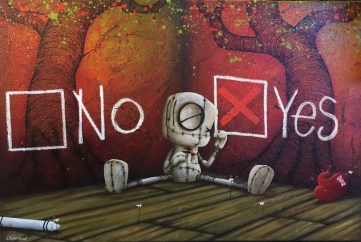
Then what is it? What is the Achilles Heel of the resilient? What is the repelling force that stands counter to the success of leaders brave enough to shake off a world that tells them No No No when all they hear in their heads is Yes Yes Yes?

Presume for a moment this entrepreneur is You. Get your highlighter ready. You’ll want to make note of this for the rest of your career.

The problem might be YOU.

Don’t highlight that. I haven’t gotten to the important part yet. The part you need to highlight is this:

If you’re not going to listen to the critics who will tell you every reason in the world why you are going to fail—and believe you absolutely must tune them out in order to be a renowned, world-class leader—you are going to have to be the hardest critic in the world on yourself.

Yes, in order to earn the privilege of ducking all the pessimists trying to steer you away from your dream, you must beat yourself up in ways they can’t even imagine. There is no luxury in resilience. There is only a level of self-critique so necessary that the pain it will cause you as a lone wolf makes child’s play of the third-party negativity you will never hear. What you hear in your head must be far more thundering—and far more impactful.

The real reason most startup leaders fail

It’s not because of a lack of devotion, or a lack of passion, or even because of a lack of talent.

They fail because of a lack of self-critique.

Does this apply to you? Have you actually established yourself as your own toughest critic? I don’t mean a little tough. I mean vicious, brutal, send yourself into a tailspin tough. Sorry to break the news, but that’s why Walt and Steve were often perceived as miserable. They were always very, very tough on themselves, an order of magnitude more thrashing than what any bleacher critic was or even could have been.

I have had the privilege to lead a handful of creative companies and I have had the privilege to be a published author. In all cases I was told innumerable times why I would not be successful. I didn’t hear a word of it. I didn’t need to hear a word of it. In all cases I was already way ahead of the peanut gallery, working and reworking the scenarios of why I wouldn’t be successful.

I study product features like I study word choices. I might tell you that no one on the market has anything like this, but before you’ll hear me utter those words, I have done the homework to assure myself this is worth defending. No one else can do that as stridently as I can. I say “no” to a sentence a hundred times before I let you see it. I edit it, erase it, rewrite it, rework it, change it, question it, then pick it apart word by word until I have exhausted all its failures. Same with a product. Same with a service.

I can only ignore the amateur naysayers because I am my own best professional naysayer.

Let’s take it deeper, to a place you may not want to go. Here’s another reason why startup leaders fail: they doggedly champion a product that is no good. It’s not because the naysayers are right. It’s because the startup leader doesn’t embrace the radical discipline to relentlessly question themselves and, by extension, their product.

If running out of time and money don’t apply as explanations, most entrepreneurs fail for a very simple reason: their idea was not good enough to create a category defining product or service. Too often we dupe ourselves into believing the ordinary is extraordinary. We fall in love with an idea because we gave birth to it, and rather than beating that idea into something exceptional—or dumping it, learning from it, and finding the fortitude to reinvent it into something else—we tell ourselves we will not be dissuaded and we go to market with mediocrity. That’s when we get walloped.

Once again, the tough love, get out the highlighter:

The only way you can defy the odds and ignore the critics is if you have a massive built-in crap filter. If you don’t want someone else to tell you your product is crap, you better be willing to tell yourself it’s crap or you’re going to blow a lot of time and money on nothing.

Artists and inventors have a crap filter no matter how successful they are. Walt did. So did Steve. Walt was told that audiences would never want to see a feature-length animated motion picture. He didn’t hear it, because Snow White and the Seven Dwarves was already worked out in his head, after he had rejected every possible way to make it something people would never want to see.

Steve was told there would never be a market for something as intimidating as home computing. He didn’t hear it, because the Apple II was already worked out in his head, after he had rejected every possible way that it would intimidate people.

Both of these visionaries agonized over perfection and were never satisfied. When they were starting out they were never satisfied. When they were at the bottom they were never satisfied. When they were at the top of their game they were never satisfied. The critics failed to resonate with them because they were lightweights in comparison to their own pounding criticism.

Are you embracing this burden of innovation?

Why do I need you to hear this? Why is this so desperately important to everyone who wants to make a difference and change the world? Because too many hopeful leaders are embracing the rhetoric of “going their own way” without embracing this burden of innovation. Every single day someone shows me a derivative app and begs me to believe in them. It’s a minimum viable product, they tell me, they will build on it and make it great later.

Right, after customers have yawned.

You really think they’ll give you another chance? So yours is 12% faster than your competition? So what? So yours addresses a tiny niche with a quirky set of differentiating features that matter mostly to you for pitching on demo day… So what? Get your eyes off the IPO listings and back on the shelf where the war for customers is lost or won. Don’t be Happy. Be Grumpy.

Incrementality is toxic. Don’t tell me how all your competitors have slightly weaker products than what you’re proposing. Convince yourself you can blow my mind with something that leapfrogs the entire market if not in one product cycle then over a generation. If you don’t want me to tell you that your app is crap then be sure you’ve asked yourself a hundred times before you ignore me. If you don’t know that your app is crap because you aren’t being honest with yourself then you haven’t earned the right to ignore the naysayers.

That’s the secret sauce—knowing when you are ready to play and when the cards you hold are not worth playing. Be that critic and you’ll never need another. When you stand up onstage and tell your story of success, it will undoubtedly be preceded by the chapters of failure that led you to your day in the sun. I want to come to that speech and applaud. I want to see you do it again and again. I want to see you tell the naysayers to jump off a peer.

Are you ready to take on the responsibility of being your own toughest critic? Wield your inner critic in such a way that it allows you to do the best work of your life. Then yeah, tell us all to bugger off and let’s get to work changing the world.

_____

This article originally appeared on The Modern Team.

Photo Image: Courtesy of Exclusive Collections Gallery (Fabio Napoleoni)

Leading Teams Toward Success Using People, Products and Profits

I’ve written the words People, Products, Profits (In That Order!) so many times over the years it would be easy to think of them as simply a slogan I use, a catchphrase meant to pique your interest. I assure you this is no more the case than Apple using the words Think Different as a clever tagline. Like the words Think Different, People-Products-Profits is part management philosophy, part rallying cry, and in an aspirational context, part religion. When I invoke these words to set the table for embarking on the outrageous, it is with the full knowledge that I could sound silly, fail miserably, fall on my face, or possibly convince you that relentless pursuit of the extraordinary is within your grasp. That’s a lot to bite off in a very few words. It’s meant to be.

In my new book, Endless Encores, a veteran CEO named Daphne spends an evening talking with an up-and-coming executive named Paul, helping him come to terms with the potential first failure he could be facing following a huge initial success. They are stuck in an airport, passing the hours. She is a leader and he is leader, only at the moment he is too obsessed with his own personal exposure to realize that he is failing to be a leader by trying to duck out of the way of his own mishap. By worrying more about what he has done than what he has learned, he has shifted the weight of his problem from marginal to endemic. In truth, the failure he might be facing is not so much a setback as it is an opportunity. By the end of the story, he has embraced that and reset his sights on the long game.

Save for the guidance from Daphne, Paul might have missed the boat. And the plane. And all that might have been ahead of him in the form of material reward, passionate accomplishment, intellectual richness, and emotional fulfillment. It’s a close call, but he makes it over the coals. You can, too, if either you have a Daphne in your corner and you’re willing to listen, or if you otherwise come to acknowledge your role as a leader is more about the long-term example you set than the specific offering you at the moment champion. One is permanent and tangible, the other fleeting and beyond your control. Where would you prefer to focus?

Leading through People, Products, and Profits means committing to the idea that talent is a priori to all success. This has much less to do with your own talent than the talent you assemble, empower, and inspire. World class products and services don’t create themselves. They are created by human beings, most often high performance teams, and the time you devote to building and bolstering those teams is a direct reflection of your values.

When your team identifies a product concept that is worth pursuing, leadership becomes the championing of execution over the touting of an idea. We can all dream up big ideas, but few of us can bring them to market. Those who can almost invariably need some form of stewardship to hold the team together through unending punch lists of details. If that’s not challenge enough, you can have the best team in the world and the best product in the world, but if your business model is not sensible and doesn’t sustain the enterprise, it really doesn’t matter what you set out to accomplish. A business has to create value, usually measured in the form of profit, and if you can’t lead a team to do that more often than not, you’re not likely to get many chances to stand in the center ring.

The point of the rallying cry is to set a tone of priority, balance, and perspective. Everyone likely wants a business that is profitable, but leaping straight to the outcome ignores the most valuable element in the mix: your customers. An exceptional team that has been well-directed puts the customer in first position, in essence their supreme boss, with the primary hope that if a customer’s expectations are exceeded, that customer can become a customer for life. When we talk about the notion of lifetime value, we are talking about just that: Have we surprised and delighted a customer in such a way that they ascribe emotion to the brand we represent? Will they come back for more with cost-effective prompting, and will they tell their influence circles about the breadth and depth of their fine experience? That’s why a business leader is accountable first to customers, because they hold all the cards, and that’s why when they pursue a business opportunity, they place investment in talent first, product innovation second, and business model third. You need all three, but put them in the wrong order and you are left extracting value from a customer rather than bonding a customer who becomes a partner in creating value.

Yes, you have to juggle three balls at once in sequence if you want to repeat success, and you have to do it over and over. It’s not easy and it’s not supposed to be easy, because if it were, you wouldn’t be worthy of praise or wealth because anyone could do it. Likewise, leadership is a choice. It’s not for everyone. The rewards are far often more intrinsic than measurable, and falling on your face in a public forum is never going to be fun. You will fail. We all fail. If you learn when you fail you will also win. You have to decide if leadership is really something you’re ready to shoulder. If you are, choose your words and the order of those words carefully. The talent around you will only become cynical if you’re insincere and don’t stand for something more than winning right now.

Repeating success is about the journey. Leading is about tone and substance. Projects are always short. Careers can be short or long. The choice is always yours. Your values always matter. If you’re deliberate in determining how you build a culture of shared values, the best around you will always be listening. Stay authentic and their results will surprise you. Those are likely to be extremely pleasant surprises.

_____

This article originally appeared on Leadership Now.

Photo courtesy of Free Range Stock

Act Two Begins When You Say So

F Scott Fitzgerald“There are no second acts in American lives.”

  • F. Scott Fitzgerald, The Last Tycoon, 1941

“I once thought that there were no second acts in American lives, but there was certainly to be a second act to New York’s boom days.”

  • F. Scott Fitzgerald, My Lost City, 1932

Like many everyday admirers of American literature, I grew up only hearing the first use of Fitzgerald’s famous quote, which in fact was published posthumously. And like many people who misinterpreted that quote due to a lack of context, I grew up confused, conflicted, and even angry every time I read it. Fitzgerald the social observer worried about the American Dream, but he also celebrated idealism and courage. Would he want to be remembered for an inaccurate observation that is not only untrue but damaging? I doubt it.

Without diving into a diatribe on American literature, let’s just lift from the earlier interpretation of Fitzgerald’s quote and bury the latter forever. To the complete contrary, I assert with full confidence that it is entirely the DNA of American lives to reignite with second acts—in many cases, multiple second acts. In fact you can have as many acts as you want. Your life’s work can be singular, dual, multifaceted, multithreaded, a sine curve of milestones, or a pastiche of overlapping landmarks. If anyone tells you otherwise, run away as far as you can as quickly as you can and clear your mind of the naysayer’s rub.

Our economy is a place that celebrates reinvention. Our democracy is a place where resilience triumphs over cynicism. I believe these things not because I am a Pollyanna motivator (quite the opposite if you know me), but because I see these traits in winners who repeatedly defy the odds. Entrepreneurs, respected leaders, creative professionals who challenge the status quo—they all have to be good at what they do, but they all get knocked down for believing that change has to happen. They seldom bring change to the world on their first try, and when they win, they seldom win once. Why is that? Because before Act One is over, Act Two is in the works, and probably Act Three.

There is only one thing that can prevent an Act Two curtain from rising: Your own decision that a failure is too much to bear. The Information Age has turned that notion wholeheartedly on its head. As long as there is learning extracted from failure, failure is a pit stop, not an endpoint. As long as risk is sufficiently mitigated to bypass a cataclysmic wipeout of resources, you are not failing if you are learning. You are on a path to where you need to go. You are on your way to Act Two.

Read Walter Issacson’s biography of Steve Jobs. We all know Jobs founded Apple. Then he got kicked out of his own company for being an uncontrollable rebel, the very thing that put Apple on the map. Jobs gets fired around p.206 in Chapter 17. He is personally devastated, emotionally crushed. That’s when his Act Two begins. The book ends on p.571 in Chapter 42. Through it all, Jobs’s Act Two is fueled by a spirit of resilience and a commitment to personal reinvention. He lives an arc that resonates.

Read Neil Gabler’s biography of Walt Disney. Disney Bros. loses control of Oswald the Lucky Rabbit around p.109 in Chapter 3. Mickey Mouse is born in Chapter 4. Snow White and the Seven Dwarves—which simultaneously almost crushed Disney’s financial interests and then put the Disney name into American lore forever—arrives in Chapter 6. Disneyland doesn’t even make an appearance until Chapter 10. The book continues until Chapter 11 is finally exhausted on p.633. If you’re looking to count second acts, start early.

Reinvention does not only apply to the famous. When I personally decided to return to writing after a twenty-five year hiatus, a lot of people made snide remarks, both to my face and behind my back. I had enjoyed a respected career in management at the intersection of entertainment and technology, but I never wanted to consider that my whole story. Starting over and writing a novel with a half-century under my belt seemed absurd to almost everyone around me. I would be competing with established authors who had amassed a lifetime of credits. I would be doing it for a fraction of the income I earned previously. There was absolutely no way to predict critical or commercial success of any kind. Critics can be harsh, public evaluation even more ominous. It was a challenge filled with possibility, a path to sharing ideas with authenticity and voice that was mine. That sounded like a decent Act Two to me. I wonder what Act Three will be.

In my new book, Endless Encores, a seasoned CEO spends an entire evening stranded in an airport executive club talking with a rising young manager who is about to hit the wall on his first failure. The less experienced leader is terrified that all he has ever wanted to achieve is about to be lost in a single product cycle. It’s a business parable, with only a few simple plot points, yet it encompasses a Socratic dialogue around what it means to learn from failure. Daphne, the veteran, has survived a seemingly infinite number of product launches, enough of them successful to keep her in the game. Paul, the rookie, comes to learn what it means to embrace resilience and reinvent himself to form a career of linking “acts” that over time reveal the arc of his personal development.

Neither Daphne nor Paul would ever buy into the idea of a terminal Act Two, let alone Act One. That’s a driving factor in the purpose that underlies their lives. Products have to sell, but more importantly, teams have to work well together and values have to emerge as shared conduits to satisfaction. Few of us get this right the first time. No one gets it right every time. You don’t have to get it right every time. You just have to know that potential for improvement always exists, recognize the aspiration for excellence as a mandate, and approach the ideal with unbridled enthusiasm. The curtain goes up on Act Two when you commit the passion to ensuring that it happens.

Don’t misquote or misunderstand Fitzgerald. Don’t tell me there are no second acts in our lives. As long as you are learning and readying yourself for what comes next, you can start anew any time you want. The courage to pursue that can only come from you.

_____

This article originally appeared on The Good Men Project.