Everyday Innovation

You don’t have to be an entrepreneur to be an innovator. Becoming a startup CEO may not be your thing, but changing the world is always within your reach.

There is a frenzy of late among those longing to lead business startups, and that is exciting. Entrepreneurs are a special breed, and while the successful ones are rare, no one really knows who is going to be successful in advance. Naysayers will tell you what you can’t do, and only you can prove them wrong.

When we talk about innovation, that undoubtedly points to entrepreneurs, but I’d like to think it not exclusive to them. Innovation is a process where creativity is harnessed, often galvanized through the building of momentum and the sharing of a vision. Often a new project or the reinvention of a product type begins with very few people involved, perhaps only one. The idea is refined and vetted, resources are added, more people get onboard, a consensus around a feature set emerges, and eventually it comes to be owned by a team. If you’ve ever been a part of this kind of team, you know how invigorating the process can be.

A subset of this process is the highly competitive world of funded startup companies, and that is a different beast entirely. In a quite insightful op-ed in the Wall Street Journal about the trials and tribulations of Uber, Andy Kessler recently noted the sometimes seething nature of a startup CEO who makes it through the hurdle of significant investment in their ambitions to excavate a gold mine:

Hubris becomes an asset. Startup CEOs are always saying the goal is to “suck the oxygen out of the room” of their competitors. Success requires a certain bravado. That should be encouraged, but most entrepreneurs have no idea when to turn it off.

There’s nothing wrong with being competitive, embracing ambition, and wanting to do the impossible. Does the goal of that have to be the annihilation of those who currently populate a market segment? Maybe because it’s the holidays, I wonder how that thinking aligns with Give Peace a Chance, but I think you can change the world without an ethos of leveling good chunks of it.

It is important to our economy and financial well-being that new companies are constantly born, that creative destruction replaces old opportunities with new ones. It is also limiting to evaluate innovation on this metric alone. If the only creativity that receives our highest praise is the moonshot IPO or breathtaking acquisition multiple, perhaps we send a difficult message to our colleagues and children that commercial success is the most important success. Do we really believe that it is somehow less noble to be part of reinvention that is not about clubbing a competitor over the head and walking away with his or her bounty?
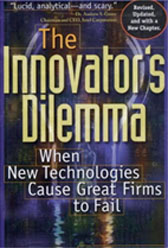
Innovator's DilemmaMuch has been written around the concept of disruption, where traditional ways of doing things are derailed in almost unbelievably short periods of time. We saw it happen with music and video, where digital media disrupted the business model of selling and renting physical media. We’re seeing it happen with the news business, most recently evidenced at The New Republic, where the economics of professional journalism are colliding with the realities of recovering its cost. Disruptors are a very real force as author Clayton Christensen so clearly taught us in his landmark book The Innovator’s Dilemma, but is it an end unto itself? What if someone doesn’t want to be a war-declaring disruptor?

There are all kinds of ways to define admirable innovation. Truth be told, very few of us are going to draft a business plan and schlep from angel to venture to institutional investors with an all-or-nothing mentality. If that’s not you but you still feel a hunger to join the reinvention movement, here are seven concrete ways you can embrace innovation right now:

  1. Give Yourself a Stealth Performance Review: Secretly write down exactly how you think you are doing at work. Be as candid as possible. Conclude with a set of recommendations for improvement. Pick one. Do it.
  2. Ask Your Boss for a Problem: Walk in and say, “How can I take a burden off your back? Give me something on your to-do list that is important but you don’t have time to do. Let’s brainstorm it together.” Always remember that every problem is an opportunity.
  3. Clarify Your Brand Promise: If you don’t know what your company stands for, ask someone in senior management for some evangelism around your company’s brand. Then look at the work you are doing every day. Does it align with the brand promise? If not, what tweaks can you make to your daily tasks to bring you personally more in line with your company’s expressed mission?
  4. Help a Non-Profit: Find an organization near you whose values and mission you embrace. Contact someone there in a leadership capacity. Tell them you want to help and what skills you have to offer. Ask them what is on their plate that isn’t being addressed. Address it.
  5. Fix Your Personal Budget: Develop a formal income statement for yourself or your family. Write down all sources of revenue and expenses. Look for areas where money is leaking out that needn’t be. Plug the holes. Get your credit under control. If you have longer-term needs, create a formal plan for getting there.
  6. Get a Hobby: Right, you don’t have the time. Yet a hobby allows you to abstract so many of your daily thoughts and tie back that problem solving to your everyday responsibilities. Plant a garden, bake, follow a sports team, adopt a pet. Don’t think of it as a diversion, think of it as a commitment to lifelong learning and self-improvement. Push yourself to approach it slightly differently from those already doing it.
  7. Coach a Friend: Look around your circle of acquaintances for someone who might be struggling a little. Offer to be a coach or mentor for the next six to twelve months. Ask nothing in return. I promise you the ideas that will emerge from your discussions will be as valuable to your personal growth as they are to the friend. Ideas and energy compound when shared. You may forget who is coaching whom.

Startups can be cool, but all innovation does not require a startup environment. Creativity is a process that leads to all kinds of new stuff, and it also exhausts dead ends around stuff not worth doing or not ready to be done. Instead of making a hollow new year’s resolution, pick a path to one of the above suggestions or come up with your own idea for reinventing the world around you. Everyday Innovation is there for the taking. Go make change happen, and I’ll see you at the starting gate!

Dreaming and Doing

Some people focus on dreaming. Some focus on doing. The ones who find a way to bridge the gap make change happen. Every once in a while, as Steve Jobs would say, they put a dent in the universe.

Many people elicit feedback. A few of them take something away from that feedback and apply it to what they are dreaming and doing. Yet too many solicit the feedback and then bat it away, a check mark on their roadmap to convince themselves they are not building in isolation. They have no interest in taking their vision to another level if it means wandering a bit from a too rigidly determined path.

The combination of dreaming and doing creates the flint and steel of innovation. Without both the status quo rules.

The combination of listening and interpreting is what hones an idea and an action plan, shaping and molding it into a viable product.

Walt-Disney-2Walt Disney said, “If you can dream it, you can do it.” For decades I’ve been trying to decipher what he really meant by this. What I do know is that this calling is aspirational. It is incredibly difficult to meet this challenge. Walt defines a promise, then delivers the promise. This has taught me that when I make a promise to customers, I must be fully committed to delivering on that promise. If I allow a gap to remain between dreaming and doing, the dream becomes cynical. Failure is okay if it’s part of the path of learning, but a cynical promise is never okay. That’s when words become hollow, and customers abandon a brand.

Recently on a cross-country flight I saw the movie Jobs.  I don’t know if it’s a great movie, but it did remind me clearly of Steve’s near maniacal obsession with perfection, with making excellence a reality, with getting everything right. That’s a standard that will surely break the mediocre and inspire those who want to be inspired. He was a dreamer, he was a doer. In his own weird way, he was also a listener. You had to listen closely to hear where he was hearing, but Steve was always listening.

Walt Disney was always listening as well. He would sit in the center courtyard at Disneyland and listen to the people around him. He never stopped dreaming. He never stopped doing. He never stopped listening,

Over the past few years I have worked with several emerging companies, to help them craft and realize their articulated strategies. I have seen magnificent dreams get stuck either because they were too unformed to realize or because the dialogue around the table became stunted by poor interchange. When you travel a great deal and interact with a wide range of customers, you begin to see the difference between actual listening and pretending to listen. You also see the results—who is gaining ground and who is stuck at the table. In my observation, the people stuck at the table might still be dreaming instead of doing because they are not listening.

As a team grows, the voices on that team expand, none more important than the voice of the customer. Does that mean a powerful vision should be diluted into compromise so everyone’s voice is incorporated? Of course not! I have written about that many times before, secure in my belief that product development is not democratic. A big idea is almost always pure, and consensus is not the same as compromise. Yet I have also sat in the room when the small spark needed for bringing dreaming into doing was snuffed out time and again. No matter how many times it was said, it was not heard. Thick heads prevailed. The status quo ruled. An ordinary idea was dressed up as something extraordinary only to be exposed as counterfeit when stared down by paying customers.

The bigger the dream, the harder it is to get it right.  Listening, editing, sifting through, and interpreting feedback is your path. That’s how you build engagement. That’s how you build momentum. That’s how you build loyalty.

Big dreams are rallying cries; small dreams are not. Incremental dreams do not put a dent in the universe. Dreams that overcome entrenched hierarchies fire up those around you and fire up your customers. The fire starts with a spark. The spark? Listening.

Business is pragmatic. Say what you are going to do and then do it, otherwise your brand promise will be empty and your customers will abandon you.

Dream big, but understand that once you share a dream, you must be committed to bringing it to life.  That is a dream worth dreaming, worth fighting for, worth sacrificing for, worth celebrating.  Hold people accountable for their role in the dream and cause them to own a share in its success.  That is a much more worthy endeavor than just doing a job.

And listen.

The end of each year is a great time for personal reflection. What can you do next year that you weren’t able to do this year? Are you dreaming it or doing it? And as you embark on doing it, make a point of listening to those you need to hear. Then make the hard calls, just like Steve Jobs, just like Walt Disney.

The Art of the Winback

Last month I wrote a post called How to Lose a Customer for Life for Ten Bucks. I received a lot of feedback, mostly private and positive, but some people didn’t understand my point. I have no interest in punishing a business that lets me down. I simply choose to redirect my business to someone who wants it more. I applaud entrepreneurs at every level, but first and foremost, my mantra of “People, Products, Profits—in that order” is not directed exclusively toward the People who run the business. It extends to the customers who are served by the business, the suppliers and partners who support the business, and even the investors who champion the business. The People part of business is unending, complex, fascinating, and a noble bedrock on which to establish competitive advantage.

Dilbert Customer ServiceNowhere is this more true than in the discipline and practice of customer service. My key point in the tale of enforcing restaurant corkage as specified by company policy despite customer confusion was not that the restaurant owner had upset and lost me as a customer by not showing concern for my concern. It was that he had willingly tossed into the incinerator an opportunity to bond me as a customer forever, future cost of acquisition priced at zero.

This is the takeaway that matters: Any botched moment in a transaction is a moment of truth, a distinct fork in the road that will lead you to one of two places, separated or hitched. Mess-ups are good. Mess-ups are big-ticket fountains of light. A momentary instance of failure is the single best opportunity a business will ever have to connect with a customer’s conviction. Understanding that a boo-boo is not a lethal wound is as simple as knowing that almost anything gone wrong unintentionally and without malice opens the door to a celebrated winback.

When something goes wrong, you have a unique opportunity presented to you on a platter. This is opportunity you can’t create intentionally in good faith; it happens when things go astray in a way you hadn’t planned. When something goes boom, you can lose your customer or you can save your customer. They are likely both forever choices. You get to decide. You just have to make that decision on the spot, quickly and correctly.

The error can be your friend if the winback is always what you keep top of mind. Do it right, reach beyond the customer’s expectations, they’ll be back again and again. It works every time.

You just bought your child an ice cream cone from a local vendor in the park. Your child takes a bite and drops the cone on the ground, eyes already beginning to tear. The vendor can offer up a free replacement before you ask, or else charge you for another one. Of course the free one hurts his pocketbook. Which choice makes him the hero you always come back to find?

You arrive at your hotel room late at night and discover the bed is not made. You’re tired, perturbed, and frankly a bit shocked. You call down to the front desk, not exactly joyful. The attendant at the front desk sees no other rooms available on par with yours, leaving the options of sending up a housekeeper or upgrading you to a suite. It’s a busy time of year and the attendant is pretty sure he can sell the suite in the next hour at triple the discount price you paid. What’s the attendant’s best move?

You pick up a half-dozen shirts from the dry cleaner. Your favorite one has been returned with frayed cuffs. The owner has seen this shirt come through more than a few times, and everyone knows that laundering can be harsh on pressed cotton. You complain that this was your favorite shirt and you really hadn’t sent it to the cleaner that many times, although maybe you had. The owner can delete the cost of cleaning that shirt, offer not to charge you for that order, or offer you the replacement cost of the shirt. What will serve you and the owner best?

What is at stake here is nothing less than the lifetime value of your customer. In any one of these cases, the customer might refuse the act of good will and make due, but your kind offer is unlikely to be forgotten or undervalued. If the customer does take you up on your generosity, you might have invested in ten times or a hundred times the business. All three of these examples are real for me, not the exact circumstances, but close enough. As a result, I make a point of where I buy ice cream, which hotel chain I favor, and which dry cleaner gets my laundry bag every single week. Honestly, I can’t remember whether I took their offer or not, but I remember the point of failure, I remember the response attitude, and I now am as loyal a customer as I could ever be, way more so than if the failure had never occurred. The winback is that powerful. It makes bad into good, good into great, temporal into forever. No advertising can do that, no coupon can do that, no promotion can do that. Only a person can do that by making a smart choice that is authentic and heartfelt.

Are there awful customers who will take advantage of merchants and service providers? Of course there are. As I said in my prior article, the customer is not always right. Sometimes a truly miserable customer will force the point of failure to see what goodies will come, even lie about the unmade bed to sneak a free upgrade. Yes, there are good customers and there are bad customers. Decide which one you’re dealing with and act accordingly. My experience is that if you worry less about whether there is a charade before you and more about the immeasurable value of the winback opportunity, the bucket of winback business will fully offset the times you get beat for your graciousness.

Good business starts at the front lines, where those who interact with customers are meeting their true boss. All the small things we can do to make businesses better at any touchpoint can add longevity and prosperity to the enterprise. It’s that kind of creativity I most encourage when a winback is at hand.

Go on, get out there, and start winning ’em back! Reach way out. It’s worth the stretch.

____________

Image: Dilbert.com ©Scott Adams

How to Make a Family Happen

Volunteering and serving on non-profit boards has been an integral part of my life. For the past 14 years I have been deeply involved with Hathaway-Sycamores Child and Family Services, which is one of the most expansive agencies serving  Los Angeles County. Hathaway-Sycamores will impact the lives of more than 8500 children this year through 26 innovative programs, from residential care and counseling for youth at risk to foster family placements and permanent adoptions.

Our signature fundraising event each year is called Celebrating Children. We invite all our wonderful donors and sponsors to this gathering in the fall, and for the second year we have held it in the Stadium Club at Dodger Stadium when the Dodgers play an away-game. I am the event chair as well as the MC, which gives me the privilege of working closely with our dedicated staff all year-long to bring friends together in a room filled with love. We broadcast the game on a multitude of monitors and invite a retired Dodger Great to join us. This year we welcomed the legendary Ron Cey to talk a little about his career and a lot about how the Dodgers are also rooted in community service. We then honor one  or two of our supporters with our highest service award, and this year that went to my dear friends, Annsley and George Strong, longtime contributors of their time, money, and vision to the kids and families of Southern California.

All that is wonderful, but it’s not what I really wanted to post just now. We held the event earlier this week, and as we do each year we made a short video that shows a bit of our work. This year we focused on foster care and adoption. We called this story: “How to Make a Family Happen.” The words I write will never do the mission or impact of this work justice, so please have a look:

The Gutierrez and Puccia families who appear in this video were with us at the event, and there were not a lot of dry eyes in the house. They are examples of what happens when individuals decide in their own way to make a forever family happen. These stories are powerful, and they are just two of the miracles we can help make real, to bring a touch of hope and light to a troubled world. If you want to support the kind of work exemplified here, please visit our website.

Please share this video with anyone whose life you think it might touch. There is so much work we can do to improve our communities, and it all begins with local stories of caring and success.

Together, we can make families happen.