Records So Good We Bought Them Again (and Again)

Fleetwood Mac - RumoursI guess for me this is turning into The Year of The List! Earlier this year, inspired by a Writers Guild initiative, I catalogued a suggested collection of the Funniest Screenplays of All Time. Right around that time, inspired by the Fleetwood Mac reunion tour, I found myself thinking about musical recordings so beloved I had purchased them multiple times on replacement platforms. While the records stayed largely the same (yes, I will keep calling them records as long as I am listening to them), a series of innovations in consumer technology offered us relatively inexpensive access to personal libraries of vinyl, 8-track tape, cassette, reel-to-reel, DAT, CD, DVD, and MP3-like digital hard drive storage along the lines of iTunes. Here I am considering what I would call three-buy and above purchases for personal use, which of course live alongside AM & FM radio broadcast, satellite play, streaming services like Pandora and Spotify, and any number of less legitimate ways to file-share.

While I was pondering all thatand readying myself to attend Fleetwood Mac’s current reunion tour at the recently refurbished concert-only Fabulous Forum in Los Angeles (remembering I had attended in 1990 what I believed was the final performance of the farewell Fleetwood Mac Word Tour)what should be playing in our living room but Rumours. Yep, at home in 5.1 Dolby Surround played an album so impossibly fantastic I had bought it at least five times with each subsequent technological improvement, including the remastered scratch tracks on the latest Expanded Edition, which chronicled the development of each song. I sat there listening again to this marvel, no regrets of any kind for the many dollars spent. I have extracted so much entertainment value from this record I would gladly purchase it again. And again.

Thus it occurred to me that Rumours was not alone, and that I was not alone in the three-buy, four-buy, and even five-buy serial record purchases. Rather than pencil out my own list, I went to my social network and asked friends where they had repeatedly dumped their dough buying the same thing over and over. Below you will see an unedited list of those records, some of which I also bought a bunch of times, others of which I have never heard but may sample now. Rather than allow this list to expire in the ephemeral Facebook news feed, I decided to recreate and share it here. I think it’s a cool list, one you should feel free to expand upon in broadening our spirit of sharing.

There is definitely a late Baby-Boomer Bias to these confessions of multiple repurchase, represented no doubt by my circle of social media friends, along with our age and taste. I think you will find the publishing dates stamped for the most part between the mid 1960s and the early 1980s, when the formative years of my contemporaries had disproportionate influence on our modest discretionary spending. Not surprisingly, in the “nifty fifty” albums reported here entirely unscientifically and in no particular order, multiple appearances are logged by the Beatles, Pink Floyd, the Rolling Stones, and Elton John.

If you’re looking for any connective tissue in all these, I think you’ll need more than the music to draw a speculative conclusion. Here is my one linking observation to the extent that I recognize most of the titles: they are in one way or another albums, curated collections or song cycles of various sorts that weave into and around themselves. Much has been written about the demise of the album in this day of pop streaming shuffles. For a while when we were younger, there was a wild notion that a record album could be something of its own as a form of, dare I say it, art.

I’m not sure I have the intellectual fortitude to plow through the art manifesto, but let me just say that when I play Abbey Road I don’t skip tracks, I play it through beginning to end. Okay, on The White Album I do skip “Revolution 9” most of the time, you got me there. But Dark Side is beginning to end, Hotel California is beginning to end, and Rumours is beginning to end. Remember, when these were vinyl, that meant getting up and switching to the flip side—yes, getting up physically to hear the rest!

There is a “something of substance” in these picks that a lot of us find missing in contemporary LP equivalents that don’t even try to compose, let alone somehow unite, a dozen or more flowing songs. I think that’s why a lot of us miss the days of AOR—album oriented rock—and why we’re willing to spend anew when landmark records with recurring motifs and thematic resonance repeatedly make their way back to the virtual shelves. These albums age well, a bit like fine wine, and seldom seem dated. Absent historical and social context, most of these carefully crafted works could just as well have been recorded today and simultaneously sound modern and classic. They were expertly written, performed, and engineered with creative courage that resulted in textured, lasting impact. Good is good, great is great, and unforgettable is, well, just what the word says.

So here is a compilation of fifty records my friends found so remarkable they bought them on three, four, or even more platforms (not to mention extended or remastered versions), and will probably continue to play until their last days on the planet in whatever form they may become available:

1) Abbey Road by The Beatles

2) Sergeant Pepper’s Lonely Hearts Club Band by The Beatles

3) The Beatles (The White Album) by The Beatles

4) McCartney by Paul McCartney

5) Band on the Run by Paul McCartney & Wings

6) All Things Must Pass by George Harrison

7) Imagine by John Lennon

8) Dark Side of the Moon by Pink Floyd

9) The Wall by Pink Floyd

10) Exile on Main Street by The Rolling Stones

11) Let It Bleed by The Rolling Stones

12) Madman Across the Water by Elton John

13) Goodbye Yellow Brick Road by Elton John

14) Hotel California by Eagles

15) Quadrophenia by The Who

16) Songs in the Key of Life by Stevie Wonder

17) Blonde on Blonde by Bob Dylan

18) Born to Run by Bruce Springsteen

19) What’s Going On by Marvin Gaye

20) London Calling by The Clash

21) The Rise and Fall of Ziggy Stardust and the Spiders from Mars by David Bowie

22) The Joshua Tree by U2

23) Led Zeppelin II by Led Zeppelin

24) Lady Soul by Aretha Franklin

25) Songs of Love and Hate by Leonard Cohen

26) Silk Degrees by Boz Scaggs

27) The Point by Harry Nilsson

28) After the Gold Rush by Neil Young

29) John Barleycorn Must Die by Traffic

30) Dr. Hook and the Medicine Show by Dr. Hook

31) Running on Empty by Jackson Browne

32) Cheap Trick at Budokan by Cheap Trick

33) Black Sabbath by Black Sabbath

34) Candide by Leonard Bernstein

35) The Lady and the Unicorn by John Renbourn

36) Nights in the Gardens of Spain by Manuel de Falla

37) The Remains of Tom Lehrer by Tom Lehrer

38) The Doors by The Doors

39) Tapestry by Carole King

40) Tom Petty and the Heartbreakers by Tom Petty and the Heartbreakers

41) Berlin by Lou Reed

42) Wheels of Fire by Cream

43) 21 by Adele

44) Crime of the Century by Supertramp

45) Bridge Over Troubled Water by Simon & Garfunkel

46) Graceland by Paul Simon

47) Dreamboat Annie by Heart

48) Pet Sounds by The Beach Boys

49) Something/Anything? by Todd Rundgren

50) Rumours by Fleetwood Mac

Which “greatest albums of all time” did we miss? Probably a lot. Add your favorites in the comments below and if there is anything you discover new in the suggestions provided, let us know what it sounds like no matter the player you choose as a conduit.

Tavis and Maya

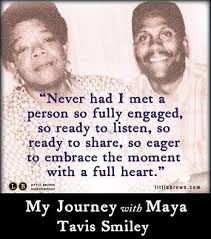
Tavis and MayaEvery year the Los Angeles Times Festival of Books continues to cement itself in my psyche as a major go-to event. Now the largest book fair in the United States, its bustling aisles fill the USC campus for two days with eager authors and insatiable readers. Each year I joyously look forward to attending, not just for the schedule of talks I plan to experience, but for the inevitable surprises I discover. This year’s surprise was an exceptionally powerful book talk on an open-air stage by Tavis Smiley about his lifetime of interaction with Maya Angelou.

Although I have not yet read Smiley’s new book, My Journey with Maya, my takeaway from the forty-five minutes my wife and I listened to him speak was profound enough to report here as a stand-alone inspiration. Smiley talked openly and honestly about how he personally crashed and burned after a failed election campaign for Los Angeles City Council following a gig on the staff of Mayor Tom Bradley. With a mountain of campaign debt crushing him, he was to be evicted from his apartment with no prospect of employment. A friend arranged a happenstance job for him to travel with Angelou on a brief trip to Africa as an assistant, mostly to carry luggage. That kicked off a lifelong friendship and dialogue between them where they didn’t always agree, but Smiley always found a way to learn.

I’m going to read the book and I hope you will as well, so I won’t go into a lot of detail here on all he said. What I want to share are the two most striking learnings from Angelou that Smiley encoded, largely because they have been stuck in my head and churning ever since we stood there in the sunshine listening to him. I have only seen Smiley a few times on television over the years, but standing in front of him, hearing his passion, listening to the heartfelt words that flowed from his inner being completely coherently without any notes or podium, I was moved completely by the sweat and memory that poured from his soul. The two ideas that Angelou planted for growth in his brain couldn’t have been more relevant to me than if I’d heard her say them to me herself. As far as I am concerned, I think I did hear her speak on both counts, channeled in full energy by his voice calling on hers:

“Baby, we find our path by walking it.”

“Sometimes rejection is redirection.”

If you think those are just broad, sweeping, generic statements of advice from the elevated dais, stop here and go read someone else’s reflection, or perhaps today’s stock market results. On the other hand, if you’re like me, copy those words onto a Post-it and put them in plain sight for the next decade or so. When Maya speaks, it’s a good idea to listen. Tavis did, and his life was reinvented.

I write a lot on this blog and in my books about resilience and reinvention, the lifeblood of innovation. When I heard Smiley put the notion of self-motivation in so few words from Angelou, I was heartened, invigorated, and inspired. She got it. He got it. I wish everyone could get it. And still, transferring the words of others into action is immensely difficult, filled with pain, buried in setbacks, and only on the most wondrous of occasions celebrated in brief victories.

Smiley was adrift after losing his election and identity in public service. He sat stunned and stared at the failed image of himself. He wanted desperately to reinvent, but had no idea how. He was frozen. Angelou saw through him to his core. “Baby, we find our path by walking it.” If it had been a Nike commercial saying “Just do it,” it couldn’t have been clearer advice: Just do something. Do anything that matters to you. Find thought in action, not in dire contemplation. Whatever you do is better than nothing, and it will inevitably lead somewhere. Sometimes I tell people to form a plan—a conceptual roadmap of any kind—not because you will follow the path from here to there, but because if you start with a map, you will go somewhere, and that has to be better than nowhere. You won’t connect the dots—the dots will connect themselves in ways you never could have imagined. Yes, you find your path by walking it. Get busy. The rest will be discovered when you least expect it.

Smiley was crushed because the electorate said no to him. He wanted to serve, but the voters said “no thanks.” Again Angelou saw motivation in the otherwise unfortunate result. “Sometimes rejection is redirection.” If the voting public did not wish to recognize Smiley as an elected official, was that the only way he could realize his dreams? Obviously not, because a few years later Angelou appeared as a guest on Smiley’s national PBS talk show. How about that? From apartment eviction to the interviewer’s chair in so little time you almost think he made the whole thing up. He didn’t. He listened. He accepted “no” as meaning “not now, not here.” Then he went another way, and his dreams were realized beyond all imagination. Can it happen to you? Yes, if you see the negative before you as motivation to go another way. That new way might be a million times more fulfilling than what you thought was your only way. We have no only way, just opportunity to be who we need to be in an as-yet undiscovered path.

Both of these precepts have been guiding lights in my own life, yet until I heard Tavis channel Maya in an unplanned walk by the stage where he happened to be speaking when I was on my way to another place, I wasn’t aware how much I shared with so many others there on the grass listening intently to every word. Maybe we are more similar than different. Maybe we all do share the same dreams of enrichment and fulfillment. Maybe if we all listen to each other a little more closely, we can help each other get from the stagnant to the unstoppable. To quote another dreamer, “Imagine.”

I sure do love the Los Angeles Times Festival of Books. I can’t wait until my walking path takes me back there next year for another dose of redirection. See you under the tents. I’ll be the guy taking copious notes, or maybe talking ideas if you start the conversation.

Everyday Innovation

You don’t have to be an entrepreneur to be an innovator. Becoming a startup CEO may not be your thing, but changing the world is always within your reach.

There is a frenzy of late among those longing to lead business startups, and that is exciting. Entrepreneurs are a special breed, and while the successful ones are rare, no one really knows who is going to be successful in advance. Naysayers will tell you what you can’t do, and only you can prove them wrong.

When we talk about innovation, that undoubtedly points to entrepreneurs, but I’d like to think it not exclusive to them. Innovation is a process where creativity is harnessed, often galvanized through the building of momentum and the sharing of a vision. Often a new project or the reinvention of a product type begins with very few people involved, perhaps only one. The idea is refined and vetted, resources are added, more people get onboard, a consensus around a feature set emerges, and eventually it comes to be owned by a team. If you’ve ever been a part of this kind of team, you know how invigorating the process can be.

A subset of this process is the highly competitive world of funded startup companies, and that is a different beast entirely. In a quite insightful op-ed in the Wall Street Journal about the trials and tribulations of Uber, Andy Kessler recently noted the sometimes seething nature of a startup CEO who makes it through the hurdle of significant investment in their ambitions to excavate a gold mine:

Hubris becomes an asset. Startup CEOs are always saying the goal is to “suck the oxygen out of the room” of their competitors. Success requires a certain bravado. That should be encouraged, but most entrepreneurs have no idea when to turn it off.

There’s nothing wrong with being competitive, embracing ambition, and wanting to do the impossible. Does the goal of that have to be the annihilation of those who currently populate a market segment? Maybe because it’s the holidays, I wonder how that thinking aligns with Give Peace a Chance, but I think you can change the world without an ethos of leveling good chunks of it.

It is important to our economy and financial well-being that new companies are constantly born, that creative destruction replaces old opportunities with new ones. It is also limiting to evaluate innovation on this metric alone. If the only creativity that receives our highest praise is the moonshot IPO or breathtaking acquisition multiple, perhaps we send a difficult message to our colleagues and children that commercial success is the most important success. Do we really believe that it is somehow less noble to be part of reinvention that is not about clubbing a competitor over the head and walking away with his or her bounty?

Innovator's DilemmaMuch has been written around the concept of disruption, where traditional ways of doing things are derailed in almost unbelievably short periods of time. We saw it happen with music and video, where digital media disrupted the business model of selling and renting physical media. We’re seeing it happen with the news business, most recently evidenced at The New Republic, where the economics of professional journalism are colliding with the realities of recovering its cost. Disruptors are a very real force as author Clayton Christensen so clearly taught us in his landmark book The Innovator’s Dilemma, but is it an end unto itself? What if someone doesn’t want to be a war-declaring disruptor?

There are all kinds of ways to define admirable innovation. Truth be told, very few of us are going to draft a business plan and schlep from angel to venture to institutional investors with an all-or-nothing mentality. If that’s not you but you still feel a hunger to join the reinvention movement, here are seven concrete ways you can embrace innovation right now:

  1. Give Yourself a Stealth Performance Review: Secretly write down exactly how you think you are doing at work. Be as candid as possible. Conclude with a set of recommendations for improvement. Pick one. Do it.
  2. Ask Your Boss for a Problem: Walk in and say, “How can I take a burden off your back? Give me something on your to-do list that is important but you don’t have time to do. Let’s brainstorm it together.” Always remember that every problem is an opportunity.
  3. Clarify Your Brand Promise: If you don’t know what your company stands for, ask someone in senior management for some evangelism around your company’s brand. Then look at the work you are doing every day. Does it align with the brand promise? If not, what tweaks can you make to your daily tasks to bring you personally more in line with your company’s expressed mission?
  4. Help a Non-Profit: Find an organization near you whose values and mission you embrace. Contact someone there in a leadership capacity. Tell them you want to help and what skills you have to offer. Ask them what is on their plate that isn’t being addressed. Address it.
  5. Fix Your Personal Budget: Develop a formal income statement for yourself or your family. Write down all sources of revenue and expenses. Look for areas where money is leaking out that needn’t be. Plug the holes. Get your credit under control. If you have longer-term needs, create a formal plan for getting there.
  6. Get a Hobby: Right, you don’t have the time. Yet a hobby allows you to abstract so many of your daily thoughts and tie back that problem solving to your everyday responsibilities. Plant a garden, bake, follow a sports team, adopt a pet. Don’t think of it as a diversion, think of it as a commitment to lifelong learning and self-improvement. Push yourself to approach it slightly differently from those already doing it.
  7. Coach a Friend: Look around your circle of acquaintances for someone who might be struggling a little. Offer to be a coach or mentor for the next six to twelve months. Ask nothing in return. I promise you the ideas that will emerge from your discussions will be as valuable to your personal growth as they are to the friend. Ideas and energy compound when shared. You may forget who is coaching whom.

Startups can be cool, but all innovation does not require a startup environment. Creativity is a process that leads to all kinds of new stuff, and it also exhausts dead ends around stuff not worth doing or not ready to be done. Instead of making a hollow new year’s resolution, pick a path to one of the above suggestions or come up with your own idea for reinventing the world around you. Everyday Innovation is there for the taking. Go make change happen, and I’ll see you at the starting gate!

Dreaming and Doing

Some people focus on dreaming. Some focus on doing. The ones who find a way to bridge the gap make change happen. Every once in a while, as Steve Jobs would say, they put a dent in the universe.

Many people elicit feedback. A few of them take something away from that feedback and apply it to what they are dreaming and doing. Yet too many solicit the feedback and then bat it away, a check mark on their roadmap to convince themselves they are not building in isolation. They have no interest in taking their vision to another level if it means wandering a bit from a too rigidly determined path.

The combination of dreaming and doing creates the flint and steel of innovation. Without both the status quo rules.

The combination of listening and interpreting is what hones an idea and an action plan, shaping and molding it into a viable product.

Walt-Disney-2Walt Disney said, “If you can dream it, you can do it.” For decades I’ve been trying to decipher what he really meant by this. What I do know is that this calling is aspirational. It is incredibly difficult to meet this challenge. Walt defines a promise, then delivers the promise. This has taught me that when I make a promise to customers, I must be fully committed to delivering on that promise. If I allow a gap to remain between dreaming and doing, the dream becomes cynical. Failure is okay if it’s part of the path of learning, but a cynical promise is never okay. That’s when words become hollow, and customers abandon a brand.

Recently on a cross-country flight I saw the movie Jobs.  I don’t know if it’s a great movie, but it did remind me clearly of Steve’s near maniacal obsession with perfection, with making excellence a reality, with getting everything right. That’s a standard that will surely break the mediocre and inspire those who want to be inspired. He was a dreamer, he was a doer. In his own weird way, he was also a listener. You had to listen closely to hear where he was hearing, but Steve was always listening.

Walt Disney was always listening as well. He would sit in the center courtyard at Disneyland and listen to the people around him. He never stopped dreaming. He never stopped doing. He never stopped listening,

Over the past few years I have worked with several emerging companies, to help them craft and realize their articulated strategies. I have seen magnificent dreams get stuck either because they were too unformed to realize or because the dialogue around the table became stunted by poor interchange. When you travel a great deal and interact with a wide range of customers, you begin to see the difference between actual listening and pretending to listen. You also see the results—who is gaining ground and who is stuck at the table. In my observation, the people stuck at the table might still be dreaming instead of doing because they are not listening.

As a team grows, the voices on that team expand, none more important than the voice of the customer. Does that mean a powerful vision should be diluted into compromise so everyone’s voice is incorporated? Of course not! I have written about that many times before, secure in my belief that product development is not democratic. A big idea is almost always pure, and consensus is not the same as compromise. Yet I have also sat in the room when the small spark needed for bringing dreaming into doing was snuffed out time and again. No matter how many times it was said, it was not heard. Thick heads prevailed. The status quo ruled. An ordinary idea was dressed up as something extraordinary only to be exposed as counterfeit when stared down by paying customers.

The bigger the dream, the harder it is to get it right.  Listening, editing, sifting through, and interpreting feedback is your path. That’s how you build engagement. That’s how you build momentum. That’s how you build loyalty.

Big dreams are rallying cries; small dreams are not. Incremental dreams do not put a dent in the universe. Dreams that overcome entrenched hierarchies fire up those around you and fire up your customers. The fire starts with a spark. The spark? Listening.

Business is pragmatic. Say what you are going to do and then do it, otherwise your brand promise will be empty and your customers will abandon you.

Dream big, but understand that once you share a dream, you must be committed to bringing it to life.  That is a dream worth dreaming, worth fighting for, worth sacrificing for, worth celebrating.  Hold people accountable for their role in the dream and cause them to own a share in its success.  That is a much more worthy endeavor than just doing a job.

And listen.

The end of each year is a great time for personal reflection. What can you do next year that you weren’t able to do this year? Are you dreaming it or doing it? And as you embark on doing it, make a point of listening to those you need to hear. Then make the hard calls, just like Steve Jobs, just like Walt Disney.